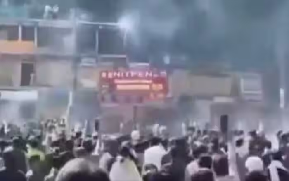

The protest in the Pakistan-occupied Kashmir has turned intense with the Pakistani Army opening fire on civilians. According to local media reports, over 30 people were killed and 200 were injured in the PoK protests after the Pakistani Military targeted civilians. Local leaders claimed that over 500 people, including children and women, have been arrested by the forces. While the official death toll is said to be around 30, unofficial claims put the figure at 400, much higher than what is being reported.
In PoK’s Rawalkot, 12 people, including eight protesters and four security personnel, were killed as clashes erupted between the members of the Joint Awami Action Committee (JAAC) and the law enforcement personnel.
Sardar Waheed Khan, the Commissioner of Poonch district in PoK, stated that 12 people were killed and several security officials were injured. He claimed that members of JAAC targeted the security forces’ personnel and the miscreants possessed modern weapons and tried to disrupt law and order in the area, Pakistani daily ‘The News International’ reported.
After the incident, strict security arrangements have been put in place in PoJK and authorities are keeping a close watch on the situation. Meanwhile, PoJK Inspector General of Police spokesperson said that four law enforcement personnel were killed and over 20 police and security officials sustained injuries in the clash.
Why are PoK residents protesting?
The clashes have been reported days after the PoJK government declared JAAC a proscribed group under anti-terrorism laws ahead of its planned protest on June 9. The JAAC had previously also held protests in PoK over economic issues and political rights. Some of those protests turned violent and caused fatalities during clashes with the law enforcement personnel in May 2024 and September 2025, The News International reported.
Rawalakot has become the epicentre of a widening wave of protests across PoK after authorities launched a crackdown on activists linked to the JAAC, a report stated.
Citing local activists and members of the movement, the ‘European Times’ reported that tensions in PoK intensified after authorities designated the JAAC as a banned organisation and rolled out a series of security measures ahead of its planned Long March on June 9. The protesting leaders also alleged that internet services across PoK had been suspended since the night of June 5, severely disrupting communication throughout the region.
According to the report, public outrage intensified following reports that Shahzaib Habib and Amjid Kashmiri, both JAAC members, lost their lives during confrontations tied to the ongoing demonstrations. It added that their deaths have become a focal point of the movement, with protesters accusing security forces of using excessive force against peaceful protesters.
Shutdown and Protests Hit Rawalakot, Kotli, Muzaffarabad
Tensions across Pakistan-occupied Kashmir (PoK) escalated sharply this afternoon as a total shutdown and mass demonstrations paralyzed multiple towns. Thousands of demonstrators flooded the streets in Rawalakot, Muzaffarabad, Kotli, Bhimber, Dadyal, Palandri, and Sudhnoti, chanting anti-government and anti-military slogans while demanding regional autonomy.
In Rawalakot, massive rallies began around 11:00 AM, with protesters effectively choking the main transit routes. The Pakistani police, military personnel, and paramilitary Rangers retaliated with live gunfire, pellet guns, and heavy tear gas to block a major march advancing from Bhimber. At least seven people have been reported wounded. Meanwhile, in Kotli, swelling crowds chanted slogans as groups of protesters began marching toward Rawalakot to reinforce the demonstrations.
Protest goes beyond Rawalkot
The unrest rapidly blanketed the wider region, with Dadyal witnessing massive rallies directly targeting the Pakistani Army. The region-wide shutdown has brought daily life to a complete standstill; commercial markets and businesses in Muzaffarabad, Rawalakot, Kotli, Bhimber, and Dadyal remained shuttered as citizens continued their agitation against the federal administration and establishment.
In Palandri, defiant protesters displayed spent tear gas canisters fired by security forces during attempts to disperse the crowds, while thousands vowed to remain on the streets. In Sudhnoti, demonstrators armed with timber sticks staged a march, issuing stark warnings to the Pakistani state. Tensions reached a boiling point at the Neelum Bridge in Muzaffarabad, where violent clashes erupted between civilians and security forces, with local footage capturing the sound of active gunfire.
What are their demands?
At the core of the unrest is a 38-point charter of demands. Chief among these are structural economic relief, including subsidized electricity and price caps on essential commodities like flour, rice, and pulses. Protesters argue that because Pakistan has constructed major hydroelectric projects—such as the Mangla Dam—on PoK territory, local residents should receive power at significantly reduced rates.
On the political front, demonstrators are demanding the immediate abolition of the 12 refugee-designated seats in the PoK Legislative Assembly. These seats are legally reserved for individuals categorized as refugees who allegedly migrated from Indian-administered Jammu and Kashmir, but who currently reside in major Pakistani cities rather than in PoK. Protesters are questioning the constitutional validity of allowing non-residents to vote for and hold these legislative positions.
What are the allegations?
Local leaders allege that the Pakistani military and the ISI exploit these 12 reserved seats to manipulate regional politics, routinely ensuring the election of Hizbul Mujahideen members and their relatives. Because these representatives live in cities like Islamabad, Rawalpindi, and Karachi, critics argue that nearly a quarter of the 45-seat assembly remains under the direct thumb of the military establishment. This allows Rawalpindi to sway legislative majorities and handpick the region’s Prime Minister.
A prominent example cited by locals is Abdullah Saeed Shah (also known as Pir Mazhar Saeed Shah), the Sindh provincial chief of the militant outfit Jaish-e-Mohammed. Despite his operational ties to the banned group, he serves as a member of the PoK Assembly and until recently held the influential portfolio of Minister for Information and Broadcasting.