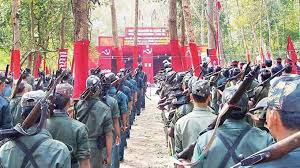

A peasant revolt in a small West Bengal village nearly six decades ago set in motion one of India’s longest-running internal security crises. Today, that movement is all but finished. The uprising in Naxalbari in 1967 gave birth to what became known as the Naxalite movement, a far-left insurgency that, at its peak, spread across swathes of West Bengal, Odisha, Jharkhand and Andhra Pradesh. Supporters cast it as a struggle for the land rights of rural and tribal communities, a pushback against exploitation and indifferent governance. In practice, it evolved into something darker — a movement sustained by extortion, intimidation and regular attacks on civilians and security personnel.
For years, the rebels maintained footholds in remote villages while drawing on support networks in cities, where sympathisers sought to keep the ideological flame alive through campuses and public platforms.
When Narendra Modi’s National Democratic Alliance came to power in 2014, tackling Left-Wing Extremism (LWE) became a stated priority. Security planners concluded that defeating the insurgency required more than firepower; it demanded confronting the narratives being used to recruit young people into the movement.
The urgency sharpened after the violence surrounding the Bhima Koregaon commemoration in 2018, near Pune. Pune Police alleged the clashes had been covertly funded and organised through front organisations linked to the banned Communist Party of India (Maoist), the unified body formed in 2004 when two major Naxalite groups, the People’s War Group and the Maoist Communist Centre, merged. Several individuals were arrested on charges of channelling funds to instigate confrontation with the state.
The government’s response took shape as a two-pronged campaign: security operations running in parallel with accelerated development in affected regions. Roads were laid into remote areas, police stations were fortified, mobile connectivity was extended, and governance gaps that had long fed local grievances were addressed.
The results proved significant. As public services improved, communities that had once stayed silent, or were perceived as sympathetic to the Maoists, began sharing information with authorities. “Development initiatives received widespread acceptance among local communities in Maoist-affected regions,” one official said. “As governance and public services improved, many residents began cooperating with the authorities.” That shift in local sentiment, officials say, became a decisive turning point.
Better road and communication links also allowed security forces to move faster and share intelligence more effectively, tightening the net around Maoist strongholds.
The government paired its security campaign with a clear message: surrender and return to mainstream life, or face consequences. Many cadres, including senior figures, chose to come in. Those who did were enrolled in rehabilitation programmes offering counselling, education, vocational training and livelihood support. Those who did not were pursued.
Large-scale operations, including Operation Green Hunt and Operation Black Forest in 2025, resulted in the seizure of substantial arms caches and the arrest or elimination of several top Maoist commanders.
In August 2024, Home Minister Amit Shah set a deadline of 31 March 2026 to achieve a “Naxal Mukt Bharat”, a Maoist-free India. By May this year, Shah declared the government had largely met that goal. Between 2005 and 2010, 126 districts were classified as LWE-affected. After March 2026, only two districts still witness any Maoist activity, and neither is considered a critical hotspot.
Attention has now turned to the cities. Intelligence Bureau officials warn that pro-Maoist elements are attempting to embed themselves in protests and foment unrest from within. “They will try to keep the pot boiling,” said one official, “but would find it very hard, as the eyes and ears of the agencies are very much on the ground.”
What began in a village in Bengal has not quite ended, but it has, by most measures, been broken.