
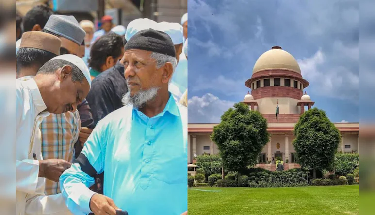

Waqf is an Islamic concept, but it is not an essential part of Islam, the Centre told the Supreme Court today while defending the Waqf Amendment Act that has sparked protests and prompted a legal challenge. “Waqf is an Islamic concept, no doubt about it, but it is not an essential part of Islam. Waqf is not a fundamental right,” Solicitor General Tushar Mehta told the Centre.
He said the government is the custodian of property of 140 crore citizens and it was the State’s duty to ensure that public property is not diverted illegally. “A false narrative is created that they will have to provide documents, or Waqf is captured en masse.”
Solicitor General Mehta said Waqf is for charity and a Waqf board only discharges secular functions. Countering the petitioners’ arguments against including non-Muslim members in Waqf bodies, he said, “Having 2 Non-Muslims, what will it change? It is not touching any religious activity.”
Earlier, Mr Mehta said a few petitioners cannot claim to represent the entire Muslim community. “We received 96 lakh representations. The JPC (Joint Parliamentary Committee) had 36 sittings. There were repeated deliberations with the JPC. They took various inputs from different Muslim bodies. Thereafter, a voluminous report was submitted, where suggestions were accepted/rejected with reasons. Then it was passed with unprecedented debate.”
On the subject of ‘waqf by user’, the Centre said that by definition, ‘waqf by user’ means the property belongs to someone else and you have acquired the right by continuous usage. “If there is a building which may be government property, can the government not examine whether the property belongs to the government?”
Countering the petitioners’ argument that the government cannot decide its own claim, Mr Mehta said the revenue authorities would decide whether it is government land, but they cannot decide the title.
Chief Justice BR Gavai said, “The picture that is being painted is that once the Collector conducts an inquiry, the property will cease to be a Waqf property and once the inquiry is complete, the entire property will be taken over by the government.” Mr Mehta replied that the government will have to file a title suit for ownership.
On the requirement that only a practising Muslim for five years can make a Waqf donation, Mr Mehta said, “Even Shariat has Section 3 that says you have to establish yourself as a Muslim. It does not mean you have to offer namaz 5 times a day or not drink wine etc. In some cases, difficulties have arisen regarding whether properties are subject to Waqf or not.”
Distinguishing between Hindu endowments and Waqf, Mr Mehta said the control over Hindu endowments is “pervasive”. “Hindu religious endowments are only religious. But Muslim Waqfs include many secular institutions like schools, madrasas, orphanages, dharamshalas etc,” he said.
Citing an example, he said the Bombay Public Trust Act governs temples in Maharashtra and its chairman can be of any religion.
Mr Mehta said a Waqf has two offices – one of the Sajjadanashin, who is the spiritual head and performs religious functions, and the second is the office of Mutawalli, who isthe administrator or manager. “First is not the subject of this Waqf case, because this law has nothing to do with religious and spiritual practice.”
Arguing that the law does not run contrary to Article 25 of the Constitution, which guarantees freedom of religion, the Solicitor General referred to the 1956 Hindu code bill that codified Hindu personal laws. “No one asked them why Muslims were protected.”
What Petitioners Have Said
Hearing the petitioners’ arguments yesterday, Chief Justice of India BR Gavai said there is a presumption of constitutionality in legislation that clears Parliament and courts “cannot interfere unless a glaring case is made out”. The bench also comprises Justice AG Masih.
Appearing for a petitioner, Mr Sibal said the Act is aimed at capturing Waqf lands. “The law is designed in such a way that Waqf property is taken away without following any process.” He also pointed to the condition that only a person practising Islam for at least five years can create a Waqf. “If I am on my deathbed and I want to make a Waqf, I have to prove that I have been a practising Muslim. This is unconstitutional,” he said.
Mr Sibal said that under the new law, any village panchayat or a private individual can raise a grievance and the property ceases to be Waqf. “The government officer will decide it and will be a judge in his own cause. No questions asked.”
“Please remember that Waqf is about my property. It is only a property owned by someone and it cannot be of the State. Now that very property is taken away,” he said.
Mr Sibal also drew a comparison between mosques and temples. “Under our Constitution, the State cannot possibly finance religious institutions. The State cannot finance a mosque for its upkeep, a burial ground has to be made through private property. So people often at the end of life dedicate their properties as Waqf. There is no chadhava like in temples. Mosques and graveyards do not have Rs 2000-Rs 3000 crore corpus.” When the Chief Justice pointed out that grants are also made at dargahs, Mr Sibal said he was talking about mosques.