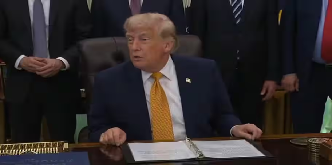

US President Donald Trump has put Tehran on notice, warning that failure to honour any agreement reached following the recent Switzerland talks would prompt firm action, and that preventing Iran from acquiring a nuclear weapon matters more to him than the risk of triggering a global economic crisis. Trump made the remarks on Monday during a signing ceremony for two executive orders on quantum technology at the White House Oval Office, where he fielded questions from reporters about the state of US-Iran diplomacy.
“If Iran doesn’t live up to their agreement, or if they’re not behaving, I will do what I have to do,” he said, before adding that cooperation from Tehran would keep things on an even keel. “As long as they respect us, we are not going to have any trouble.”
When pressed on whether military action against Iran could send shockwaves through the world economy, potentially tipping it into a depression, Trump brushed aside the concern. “Not the way I’m doing it. It’s not going to cause depression,” he said, before making clear where his priorities lie. “Nuclear weapons supersede depression. Depression is real bad… a nuclear weapon will cause depression much more quickly.”
Inspections Row Clouds Swiss Progress
The remarks follow what American officials described as a productive first round of technical talks under the 14-point memorandum of understanding between Washington and Tehran, held at the Burgenstock resort in Switzerland.
Vice-President JD Vance, speaking to reporters at the venue, said the two sides had made meaningful headway. “We laid a very good foundation for a successful final deal,” he said, adding that mechanisms had been agreed around regional stability and nuclear oversight. Vance went further, claiming Iran had consented to allowing nuclear inspectors into the country — a significant step, if accurate, towards ensuring Tehran does not develop atomic weapons.
Trump echoed that assertion in a post on his Truth Social platform. “Everybody is fully aware that Iran will agree to have Major Weapons Inspections in order to ensure ‘Nuclear Honesty’ long into the future,” he wrote.
Iran, however, was quick to pour cold water on those claims.
Iranian Foreign Ministry spokesperson Esmaeil Baqaei told state news agency IRNA that Tehran’s engagement with the International Atomic Energy Agency would proceed strictly within existing frameworks and on its own terms. “Iran’s interactions with the Agency, in accordance with Iran’s obligations under the Safeguards Agreements, will continue according to existing procedures and comply with the laws enacted by the Islamic Consultative Assembly and the decisions of the Supreme National Security Council,” he said.
The conflicting accounts from Washington and Tehran cast a shadow over what both sides had otherwise presented as a constructive opening round of talks. With a High-Level Committee now established and a final agreement expected to be mapped out within 60 days, the gap between what each side believes was agreed on nuclear inspections could yet prove a serious sticking point.
For now, Trump has made the bottom line plain, military options remain firmly on the table, and on the question of nuclear weapons, he is not prepared to blink.