
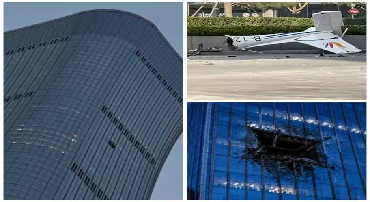

Four days have passed since a small plane crashed into Beijing’s 109-storey CITIC Tower, but Chinese authorities are tightlipped on how the aircraft entered one of the world’s most tightly controlled airspaces. The pilot, who was the only person on board, died in the crash. Thirteen people on the ground were injured. The impact punched several holes in the side of the skyscraper.
Despite the scale of the incident and its location, the government has released only limited details about the crash. The only public statement so far has come from a short 60-word report published in the state-run Beijing Daily. It confirmed the basic facts but gave no explanation about the cause of the crash.
The accident took place only a few kilometres from Zhongnanhai, the heavily guarded compound where China’s top leadership works and lives. The timing and location have added to the attention surrounding the incident.
Limited information, removal of online content
Images and videos of the crash spread went viral online in the first hours after the incident. But many of them have since been removed from Chinese social media platforms. There are reports that aviation companies were instructed to suspend operations involving light aircraft.
Officials and other stakeholders have allegedly been asked not to discuss the accident. The lack of clarity has added to public uncertainty, especially given China’s strict control over its airspace.
Beijing maintains a permanent no-fly zone covering about 100 square kilometres above some of China’s most heavily guarded government areas, including Tiananmen Square and Zhongnanhai. That makes the aircraft’s presence in the area highly unusual.
A building and a city under strict control
Also known for its distinct design resembling a traditional Chinese wine vessel, the CITIC Tower is a well-known landmark in the city. It is also seen by many locals as a symbol of good fortune and is often featured in social media posts during exam season or job searches
Following the crash, even unrelated images and memes of the building were removed from online platforms, according to several users. Chinese social media platforms removed not only videos of the crash but also unrelated images and memes featuring the building.
Security concerns and questions over airspace
A lot of people are asking how a small plane was able to fly into one of the most heavily guarded parts of Beijing. Calling it a serious security failure, a post said that if the plane had kept flying for a few more seconds, it could have reached Zhongnanhai.
Others said the aircraft’s ability to fly over a large part of the capital and come close to sensitive areas showed serious security failure. It could be a pilot error or technical failure, they said, but other possibilities also cannot be ruled out.
China has recently tightened rules on drones, requiring registration and stricter controls in urban areas. However, this incident involved a small two-seater aircraft (the Aurora SA60L), built by Chinese manufacturer Sunward Aircraft. According to flight tracking data, it is mainly used for tourism, aerial photography and recreational flying.
Comparisons and historical references
People outside China have compared the crash to other incidents in history. Some social media users referred to past aviation disasters, including the September 11 attacks in the United States. Others referred to a more similar incident from 1987, when German amateur pilot Mathias Rust flew a small plane into Moscow’s Red Square during the Cold War and exposed weaknesses in Soviet air defences.
Researchers say the Beijing incident may also lead to internal reviews. Similar incidents in the past have led to changes in security and defence leadership.
The fact that the plane got so close to a sensitive area shows that something went wrong in the way the airspace was managed. Whether the crash was caused by human error, technical failure or something else, the lack of information has left many details unresolved.