
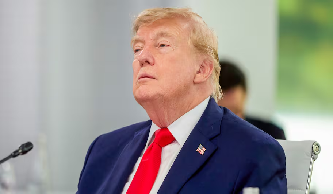

In a strong-worded address, United States of America (USA) President Donald Trump reiterated his administration’s hard-won gains against Iran, declaring that the United States is set to take possession of Tehran’s enriched uranium stockpile, material he dubbed as “nuclear dust,” while emphasising that Tehran will never develop a nuclear weapon.
The remarks come as diplomatic efforts to formalise an end to months of conflict show signs of progress, though tensions remain high and implementation faces significant hurdles, after the February 28 war in West Asia.
Trump painted a picture of decisive military success that has reshaped the regional balance.
“We’ve completely destroyed their fleet. They had 159 ships. Every single ship is at the bottom of the sea,” he stated, highlighting US naval operations that included a stringent blockade of the Strait of Hormuz.
According to the president, American forces prevented any ships from passing for two months, targeting vessels late at night when Iranian radar—already crippled by prior strikes, was inoperable. In one notable operation three weeks prior, 22 ships attempting to transit the strait were neutralised.
These actions, Trump argued, prevented a feared oil price spike to $300–$350 per barrel. Instead, global markets have stabilized, with oil recently trading near or below pre-conflict levels around $68–$72 per barrel. The reopening of the vital waterway, which carries roughly one-fifth of the world’s oil and LNG, has eased supply fears that gripped markets earlier in the year.
Tensions boiled over in 2025 with Israeli strikes on Iranian targets, followed by US bombings of key nuclear facilities like Natanz, Fordow, and Isfahan. These operations severely damaged Iran’s enrichment capabilities. A broader conflict erupted in early 2026, involving the Iranian closure of the Strait of Hormuz, US retaliatory blockades, and naval skirmishes. Iran’s fleet and air capabilities were largely neutralized, and its economy, already strained, suffered further as oil exports were curtailed.
Trump again repeated his regime change claims saying, “I went in for one reason, very strongly: that Iran cannot have a nuclear weapon. I’m not looking for regime change, although this is regime change. The first regime is gone. The second regime is gone. And I think the third regime is more reasonable.”
He stressed a preference for diplomacy over further destruction, noting the human cost to Iran’s 91 million people. Yet he warned of overwhelming capability if needed: bridges could be downed in an hour, and power plants eliminated in a fraction of an afternoon. “We can take out their electricity and power-generating plants in a small part of an afternoon. Every plant will be gone. And they know that.”
Central to the emerging deal is the fate of Iran’s enriched uranium. Trump has repeatedly vowed that the US will secure this material, whether through joint operations or unilateral action if talks collapse.
Officials have discussed on-site downgrading or removal. Iran has committed not to pursue nuclear weapons, though full verification remains a challenge given damaged sites and questions over undeclared activities.
As talks continue, with intermediaries like Pakistan and Qatar, US President issued a stark warning saying, “We’ll either make a deal or we’ll finish the job. And it won’t be tough to finish the job. I’d rather make a deal.”