
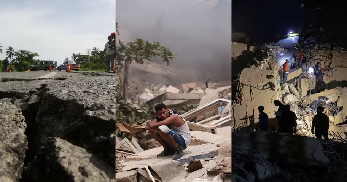

The death toll from the powerful twin earthquakes that struck Venezuela has risen to 235, while more than 4,300 people have been injured. Rescue teams are working around the clock to find survivors trapped under collapsed buildings. Authorities have warned that the number of deaths could rise further as rescue operations continue in the worst-hit areas.
Death toll climbs as hospitals treat thousands
Venezuela’s Health Minister Carlos Alvarado said on Thursday evening that hospitals have treated more than 4,300 injured people since the disaster.
While many victims suffered minor injuries, several others remain in serious condition and require surgery.
“As of 7:00 PM today, we have already attended to more than 4,300 injured people, some minor, most minor, but there are also moderate and serious cases. Many of them have required surgical interventions, and unfortunately, we have received around 235 patients who arrived without vital signs or who died upon arrival at our health facilities,” the minister said in the interview.
Hundreds feared trapped under rubble
Authorities believe around 200 people remain trapped beneath collapsed buildings.
Venezuela’s National Assembly President Jorge Rodriguez said rescue teams are working urgently to save as many lives as possible.
“We are racing against time in the hope of rescuing as many people as possible,” Rodriguez said during a press conference.
Search teams continue to clear debris while facing difficult conditions and the threat of additional building collapses.
Twin earthquakes cause widespread destruction
The earthquakes struck on Wednesday and measured magnitudes of 7.2 and 7.5.
The two powerful tremors occurred just 40 seconds apart and were the strongest earthquakes to hit Venezuela in more than 100 years.
The disaster caused severe damage across parts of the central coast and the capital, Caracas.
Buildings collapsed, power supplies were disrupted, and communication networks were affected in several areas.
Why were the earthquakes so destructive?
Experts said both earthquakes were shallow, occurring at a depth of only 10 kilometres.
Because the tremors happened close to the surface, much of their energy was released directly into populated areas.
The epicentres were also located near Caracas, one of Venezuela’s most densely populated regions.
Repeated aftershocks have increased the danger of further structural damage and building collapses.
Lack of preparedness raises concerns
Experts noted that Venezuela had not experienced a major earthquake for nearly 50 years.
As a result, many residents were not prepared for a disaster of this scale.
Concerns have also been raised about aging infrastructure and years of underinvestment, which may have made buildings more vulnerable to strong seismic activity.
Government announces rescue and relief measures
Jorge Rodriguez announced several emergency measures to support rescue and recovery efforts.
The government has ordered the mobilisation of debris-removal equipment from private companies and established a 200-million-USD emergency assistance fund.
Special credit facilities will also be provided to affected business owners to help rebuild damaged properties and restore economic activity.
International assistance begins
Venezuela is coordinating with international partners to strengthen rescue and relief efforts.
Foreign Minister Yvan Gil said the government is taking the necessary steps to manage offers of assistance from abroad.
According to officials, at least a dozen countries have expressed solidarity and offered support following the disaster.
Rescue operations remain ongoing as authorities continue searching for survivors and assessing the full scale of the damage caused by the deadly earthquakes.