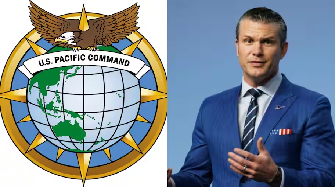

The United States Department of War has confirmed that the US Indo-Pacific Command will go back to its old name, the US Pacific Command, ending a title the military had used for more than seven decades before it was changed. Alongside the announcement, the command’s website was found displaying an inaccurate map of India, showing Pakistan-occupied Kashmir as part of Pakistan in the section outlining its area of responsibility.
The renaming undoes a change made in 2018, when then Defence Secretary Jim Mattis switched the command’s title to Indo-Pacific Command, a move meant to highlight the Indian Ocean’s growing weight in regional security and its closer ties to the Pacific.
In its statement, the Department of War said the return to the original name was about recognising the command’s roots, adding that it “honours the command’s deep historical roots, fostering a sense of pride and collective spirit among all who serve in the Pacific.” Officials were careful to add that the change is symbolic only, and does not touch the command’s duties, mission, or geographic coverage.
The department also confirmed that the command’s area of responsibility, stretching from the US west coast to India’s western border, stays exactly as it was, and that its work alongside allies in keeping the region “free and open” continues without pause.
Why this command matters
Set up on 1 January 1947 under President Harry S Truman, the command ranks among the oldest and largest unified combatant commands in the American military. It has been central to security arrangements across Asia since the end of the Second World War, with a role in major conflicts such as the Korean and Vietnam wars, as well as numerous humanitarian and disaster relief efforts.
Before this latest change, the Indo-Pacific Command served as the main American military body overseeing operations, defence partnerships, and security planning across the wider region. Based in Hawaii, it covers an immense stretch of territory taking in the Pacific Ocean, much of the Indian Ocean, East and Southeast Asia, Australia, and parts of South Asia. Its work spans defence readiness, joint military exercises, maritime security, and contingency planning.
The 2018 switch revisited
When the command was renamed in 2018, it was widely read as more than a paperwork exercise. It signalled that Washington saw the Indian Ocean and South Asia as increasingly tied to security developments in the Pacific.
For India, the Indo-Pacific Command became a key channel for deepening military cooperation with Washington, built through joint exercises, maritime coordination and broader strategic engagement. Its mandate also fit into wider regional discussions on protecting sea lanes and preserving freedom of navigation across one of the world’s busiest maritime routes.
Tharoor’s pointed response
The decision has stirred political debate back in India. Congress MP Shashi Tharoor posted a brief but sharp comment on social media, asking, “One more nail in the coffin of the Quad?”, alongside screenshots of the Department of War’s order.
His remark captured a wider unease among some observers that dropping “Indo” from the command’s name might hint at a shift in how Washington frames its Indo-Pacific approach, and what that could mean for groupings like the Quad.
American officials, however, insist the change is limited to the name itself, with the command’s structure, responsibilities and regional commitments left untouched. Whether the shift carries any deeper signal for the region remains an open question, but the move looks set to keep diplomats and commentators across Indo-Pacific capitals talking in the days ahead.