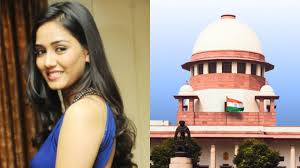

The Supreme Court of India on Monday heard the death case of Twisha Sharma and directed all possible witnesses and accused persons to avoid speaking to the media during the investigation. Appearing for the Madhya Pradesh government, Solicitor General Tushar Mehta said, “It is better to have a divorced daughter than a dead one.” He also alleged that the accused’s mother, a former district judge, had made public remarks against the deceased on television channels.
Supreme Court Stresses Fair Probe
A bench led by Chief Justice Surya Kant clarified that the court had not made any observations on the truthfulness of the allegations in the case. The court said the investigating agency must independently examine every aspect of the matter in a fair and unbiased manner.
The court also asked both families and possible witnesses to share their statements only with investigators and not publicly, so the ongoing investigation is not influenced.
Court Takes Note of Possible CBI Probe
The bench also noted Solicitor General Mehta’s statement that a decision on transferring the case to the Central Bureau of Investigation (CBI) would be taken soon. During the hearing, the court expressed concern over media debates and competing narratives surrounding the case.
Lawyers Raise Questions Over Investigation
Senior advocate Siddharth Dave, appearing for the accused, claimed that witness statements recorded by police were appearing in newspapers soon after being documented.
Meanwhile, senior advocate Siddharth Luthra, representing Twisha Sharma’s family, highlighted alleged lapses in the early investigation, including delays in filing the FIR and failure to properly preserve evidence.
Family Welcomes Supreme Court Intervention
Twisha Sharma’s father, Navnidhi Sharma, welcomed the Supreme Court’s intervention and said it would help ensure accountability in the case. Twisha Sharma’s last rites were performed in Bhopal by her brother, Major Harshit Sharma, after the family received her body following a second post-mortem conducted by a medical board from All India Institute of Medical Sciences (AIIMS). The family had earlier demanded an independent autopsy, alleging irregularities in the first post-mortem report.