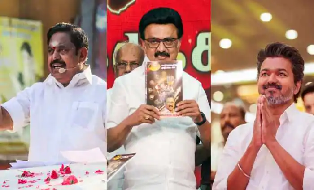

As political parties ramp up their campaigns in the high-stakes 2026 Tamil Nadu elections, it’s shaping into a fierce three-way battle.
Veteran rivals DMK and AIADMK face a fresh challenge from TVK’s rising star, with all sides unleashing fresh schemes, detailed manifestos, and voter-luring freebies to capture the state’s divided electorate.
While TVK chief Vijay released a youth-centric manifesto on March 29, 2026, framing the assembly elections as a “generational shift” and “whistle revolution” against Dravidian giants DMK and AIADMK.
The ruling DMK, in an attempt to retain power, released comprehensive election manifestos, packed with welfare-oriented promises aimed at key voter groups, particularly women, farmers, and low-income households.
The DMK, which had made 505 promises in the 2021 elections, has expanded its commitments to 525 assurances this time.
While the opposition AIADMK, in a bid to return to power with the BJP alliance, has announced 297 promises, focusing on a mix of welfare schemes and targeted subsidies.
Power play showdown: DMK vs AIADMK’s freebie manifestos
As Tamil Nadu elections take a three-way turn, old powers seek to woo voters; both DMK and AIADMK have striking similarity in their manifestos: Schemes, freebies, and financial aid.
Other major highlights of both manifestos are the emphasis on women-centric schemes. Women are seen as easy targets for electoral gains, with DMK doubling monthly aid to Rs 2,000 and offering Rs 8,000 appliance coupons for homemakers, while AIADMK promises free refrigerators and Rs 2,000 monthly support for female household heads.
These overlapping freebies aim to lock in the vital women’s vote bank ahead of the high-stakes polls.
AIADMK General Secretary Edappadi K. Palaniswami has pledged that free refrigerators will be provided to ration card holders if the party forms the government. Additionally, under the ‘Kula Vilakku’ scheme, the AIADMK has proposed a Rs 2,000 subsidy for all family card holders, positioning it as a direct benefit to households across the state.
Another striking similarity is the pledge to promise to raise old-age pensions from Rs 1,200 to Rs 2,000 and boost fishing ban relief from Rs 8,000 to Rs 12,000.
For persons with disabilities, Stalin has proposed raising the allowance to Rs 2,500, while Palaniswami has committed to increasing it to Rs 2,000.
In the education sector, the DMK has pledged to distribute free laptops to 35 lakh students pursuing higher education over the next five years. The AIADMK has also included a similar proposal, promising laptops for students studying in government and government-aided colleges.
Housing and rural development feature prominently in both manifestos. The DMK has committed to constructing 10 lakh houses within five years, while the AIADMK has promised free housing for homeless families under its ‘Amma Illam’ scheme.
Farmers are in the crosshairs with bold promises from both sides, such as hiking paddy’s minimum support price to Rs 3,500 per quintal and sugarcane to Rs 4,500 per tonne.
On healthcare, Stalin vows to raise insurance eligibility to Rs 5 lakh income and coverage to Rs 10 lakh, while Palaniswami pledges full state funding for critical treatments like heart surgeries and cancer care.
Both DMK and AIADMK firmly oppose key elements of the National Education Policy while vowing to safeguard Tamil Nadu’s autonomy. They commit to advocating for education’s return to the State List to preserve regional control.
Tamil Nadu freeies culture
Tamil Nadu’s freebies culture in politics originated in 1967 under DMK’s C.N. Annadurai with the “Epadi scheme”, marking an early shift toward populist welfare to address hunger and poverty.
The welfare schemes transformed rapidly, like the mid-day meal scheme were pioneered nationally but aggressively expanded in Tamil Nadu to boost school enrollment among the poor.
Stalwart leaders like M. Karunanidhi and J. Jayalalithaa built on these schems with educational schemes like free uniforms, footwear, textbooks, and buses, tying aid to social goals like education and nutrition.
Though these welfare schemes stayed targeted initially, but gained explosive momentum post-2006 when Karunanidhi’s colour TV promise swept elections, prompting rivals to escalate with laptops, mixers, fans, and gold, transforming it into a high-stakes “freebie war” dominating every poll cycle.
As campaigning gains momentum, the manifestos underscore a fierce electoral contest driven by welfare politics and competitive populism.