
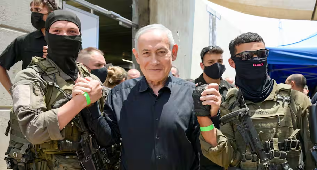

Moments after US President Donald Trump announced a deal with Iran, Israel’s National Security Minister Itamar Ben-Gvir and Defence Minister Israel Katz opposed the US-Iran deal and refused to pull back from their positions across the border. Earlier, US President Donald Trump took to Truth Social to announce a massive diplomatic breakthrough, a finalized peace deal with Iran.
“The Deal with the Islamic Republic of Iran is now complete,” Trump declared, triumphantly ordering the immediate removal of the US naval blockade and the toll-free reopening of the strategic Strait of Hormuz. “Ships of the World, start your engines. Let the oil flow!” said Trump.
But while the White House cheered the anticipated revival of global energy markets, the mood in Jerusalem was drastically different.
Within hours, Trump faced unyielding resistance from his closest Middle Eastern ally, exposing a profound rift over sovereignty, survival, and the price of international diplomacy.
“The IDF will remain indefinitely in security zones in Lebanon, Syria, and Gaza to protect Israeli citizens,” Katz asserted, emphasising that external diplomatic pressures would not alter Israel’s defensive positions.
Issuing a stern warning to Tehran, he added, “If Iran attacks over Lebanon, Israel will strike back with full force.” Reports indicate that Prime Minister Benjamin Netanyahu has personally reinforced this stance to Trump, resisting expectations that Israel will vacate territory captured and cleared of terror infrastructure.
The internal political blowback was further amplified by National Security Minister Itamar Ben-Gvir. In a post on X, the far-right minister made it clear that Israel views the pact as a threat to its existence, rather than a pathway to peace.
“Trump’s agreement does not bind us,” Ben-Gvir wrote. “Israel is not subject to the United States, and we are an independent and sovereign nation! Our duty is to the citizens of Israel, to the soldiers of the IDF, and to the Jewish people.”
Ben-Gvir invoked painful historical precedents, arguing that every time Israel succumbed to international pressure, citing the Oslo Accords and the 2006 Lebanon agreement, it paid a “blood price with interest.”
While expressing gratitude for President Trump, he firmly stated, “The State of Israel is not a banana republic.” For Ben-Gvir, nothing short of the complete dismantling of Hezbollah is acceptable.
While the US celebrates the deal’s triumph, this open defiance leaves the US-Iran deal in a fragile state. Israel’s current posture signals a refusal to lower its gaze. The clear intent of not withdrawing from Lebanon is contrary to expectations that Iran has. While there have been no official statements from Israel, the dates are set for sighning of US-Iran peace deal for June 19.