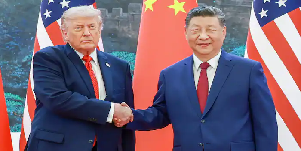

US President Donald Trump, currently on an official visit to China, held talks with Chinese President Xi Jinping in Beijing today. The White House described the high-level meeting between the two leaders as “good”.
According to the White House statement, both leaders agreed that the Strait of Hormuz must stay open and free for the flow of energy. President Xi made it clear that China strongly opposes any militarization of the strait or attempts to charge tolls for passage through it.
“President Trump had a good meeting with President Xi of China. The two sides discussed ways to enhance economic cooperation between our two countries, including expanding market access for American businesses into China and increasing Chinese investment into our industries,” the White House said in a post on X.
The two presidents also reaffirmed that Iran can never be allowed to develop a nuclear weapon. On the economic front, Trump and Xi discussed ways to boost cooperation between the world’s two largest economies.
This includes giving American businesses better access to the Chinese market and encouraging more Chinese investment in the United States. President Xi expressed interest in buying more American oil in the future, partly to reduce China’s reliance on the Strait of Hormuz.
The meeting also highlighted progress in stopping the flow of fentanyl precursors into the US and increasing Chinese purchases of American farm products.
CEOs from some of America’s biggest companies joined part of the meeting, underscoring the strong business dimension to the talks.
China’s Taiwan stand
Speaking at the Great Hall of the People, President Xi described the current global situation as turbulent and undergoing changes “not seen in a century.” He stressed that China wants a stable, sound, and sustainable relationship with the United States.
“China-US economic and trade ties are mutually beneficial and win-win in nature,” Xi said. Where differences exist, the two sides should talk as equals rather than escalate tensions. Xi emphasised that the Taiwan issue is the most important and sensitive matter in the relationship.
If handled well, it can provide overall stability; if not, it risks serious clashes that could damage the entire US-China relationship.
The two presidents also exchanged views on major global hotspots, including the Middle East, the situation in Ukraine, and the Korean Peninsula. They agreed to support each other in successfully hosting this year’s APEC Economic Leaders’ Meeting and G20 Summit.
Overall, the tone coming out of Beijing was constructive, with both sides signaling a desire to keep communication open and expand practical cooperation in areas like trade, agriculture, health, tourism, and people-to-people exchanges.