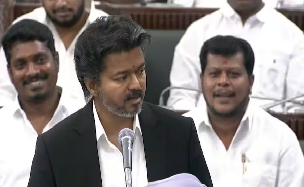

Tamil Nadu Chief Minister C. Joseph Vijay has firmly restated his government’s opposition to NEET and any attempt to impose a third language on students, telling the state Assembly that the two-language policy adopted more than five decades ago remains non-negotiable.
Replying to the Governor’s address on Tuesday, Vijay traced the policy’s roots back to 1968, when Chief Minister C. N. Annadurai moved a resolution in the very same Assembly to scrap the three-language formula and limit instruction to Tamil and English alone.
“From then until now, the two-language policy has been adopted in Tamil Nadu,” Vijay said. “This government will continue to follow this policy since it is one that the people of Tamil Nadu have accepted.”
His remarks landed at a particularly charged moment. The NEET re-examination had been held just days earlier, on June 21, after the original May 3 test was scrapped following allegations of irregularities and a paper leak. A total of 1,42,489 students from Tamil Nadu sat the re-examination across 307 centres statewide, including 43 in Chennai, under tight security arrangements that included biometric verification, digital fingerprinting and facial recognition. Authorities confirmed the exam passed off without incident.
Students who took the paper, however, described it as harder than the original test. Physics and Chemistry drew the most complaints for being lengthy and difficult, while Biology was considered more manageable. Most questions were drawn from the NCERT curriculum.
The backdrop to all of this is deeply sobering. Two medical aspirants in Tamil Nadu are reported to have died by suicide within a 24-hour period, reigniting calls from across the political spectrum to either abolish NEET or exempt the state from it altogether. PMK leader Anbumani Ramadoss added his voice to those demands, urging both the Centre and the state government to act.
Opposition to NEET has long been one of Tamil Nadu’s most potent political flashpoints, with parties of varying stripes arguing that the national entrance examination places students from the state at a structural disadvantage. Vijay’s government shows no sign of softening its stance.
A Call For Unity Across Party Lines
Beyond the language and NEET debate, Vijay used his Assembly address to appeal for cross-party cooperation on matters affecting Tamil Nadu’s broader interests.
“If we unite on matters concerning Tamil Nadu’s welfare, our state will become a leader in the country,” he said. “Even if we differ in our opinions, we must unite and work together for the welfare of the people.”
He opened his reply with a note of gratitude to the electorate. “I express my heartfelt gratitude to the loving people of Tamil Nadu, who have a permanent place in my heart, for electing the members of our Tamilaga Vettri Kazhagam to this august Assembly,” he said.
The Chief Minister also took aim at critics who accuse him of having walked into politics straight from the film industry, calling the charge nothing more than a “reel.” He pointed to TVK’s 2026 election performance, 35 per cent of the vote and 17.2 million ballots cast in the party’s favour, contested without a single alliance partner, as the clearest possible answer to those who question the party’s political legitimacy.