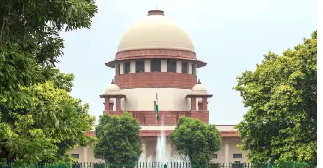

The Supreme Court delivered a stinging rebuke to Gurugram Police over its handling of a sexual assault case involving a four-year-old girl, declaring it a glaring instance where concerted efforts were made to shield the accused, and ordering a fresh investigation by a Special Investigation Team.
According to an NDTV report, a bench comprising Chief Justice of India Surya Kant and Justice Joymalya Bagchi, while hearing a petition filed by the child’s parents alleging deliberate inaction by the police, pulled up officers at every level of the force, from the commissioner downwards, for what it described as heights of insensitivity in their conduct towards the child and her family.
The court issued show-cause notices to Gurugram Police Commissioner Vikas Kumar Arora and other senior officers. It also served notices on the doctor who altered the child’s medical report, as well as members of the Child Welfare Committee. The newly constituted SIT has been directed to conduct its probe with complete human sensitivity.
The bench had previously sought responses from both the police and the district judiciary after it emerged that a magistrate had questioned the child in the presence of the accused.
A central concern for the court was the decision to reduce the offence from Section 6 of the Protection of Children from Sexual Offences Act to Section 10. Section 6, if proved, carries a minimum sentence of 20 years in prison; Section 10 carries a maximum of ten years.
When Additional Solicitor General Aishwarya Bhati, appearing for the state of Haryana, argued that the charges had been revised on the basis of a Child Welfare Committee report, the court was unimpressed. It questioned why that report was given greater weight than the child’s own statement, and told counsel plainly not to defend the indefensible.
Justice Bagchi was pointed in his criticism. “Please see the police officers, their station and position. Deputy commissioner of police, assistant superintendent of police. If this is the understanding of the offence on a four-year-old child, then what about the rule of law? Rape is not penal penetration alone. The police are clearly not aware. This is yawningly distressing. The highest police officer was involved in bringing down the seriousness of the offence from Section 6 to Section 10,” he said.
The Chief Justice was equally direct. Noting that officers had not even read the bare Act, he said the force had disbelieved the word of a four-year-old child. “Shame on them. If the state has any respect for the law, they must be immediately transferred,” he said.
He also aimed at the fifteen days of inaction that preceded the court’s intervention. “The moment we take cognizance, you start arresting. Do you want us to tell you why you were busy? This case exhibits the heights of insensitivity,” he said.
The court described the entire police response, from the commissioner to the sub-inspector, as a coordinated attempt to discredit both the child and her parents. It condemned the cross-examination of the child as the worst form of secondary victimisation and a profound act of disrespect.
The trauma inflicted on the child, the Chief Justice observed, had been multiplied as a result of the insensitive, reckless, irresponsible and completely unlawful method of investigation pursued by Gurugram police.
Senior Advocate Mukul Rohatgi, appearing on behalf of the parents, informed the court that the doctor who had examined the child subsequently changed her medical report. Justice Bagchi called this completely illegal, adding that it was all because of the clout of the Haryana Police.
The Chief Justice also flagged that the child’s name had been mentioned throughout the affidavit filed before the court, in direct violation of the legal requirement to protect a victim’s identity. “The whole day we teach, don’t disclose the victim’s identity,” he remarked.
The bench further took exception to the fact that police officers had never visited the child’s home. “Why can’t the police go to the house of the victim? Are they kings?” the Chief Justice asked.
The court reserved particular scepticism for the Child Welfare Committee, expressing serious doubts about the academic and professional qualifications of its members. It directed the Haryana government’s Department of Women and Child Development to file an affidavit explaining the basis on which the current members had been appointed.
“How can such members be appointed? What is their qualification, and what is their accountability? We know how they are selected. Their only qualification is one, but we don’t want to say anything now,” the Chief Justice said.
The court concluded that the case demanded a thorough investigation conducted in the most sensitive manner, maintaining the dignity of both the child and her parents at every stage.