
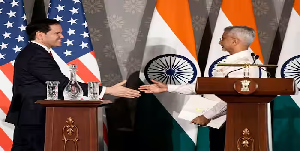

India’s External Affairs Minister Dr S Jaishankar made a clear statement on India’s foreign policy approach during a joint press conference with US Secretary of State Marco Rubio in New Delhi. He said India and the United States both operate on the principle of putting national interest first.
He made the point while responding to questions on energy trade and world supply chains. He also emphasised that while the two countries share a strategic partnership, their priorities are determined by domestic needs and policy choices.
Speaking to reporters, Jaishankar drew a direct comparison between the two countries’ approaches. “The Trump administration talks about America First in its foreign policy. As far as we are concerned, we talk about India First. Both countries place their national interest at the centre,” he said.
He added that this approach does not stop cooperation between the two sides. According to him, there are many areas where interests align and work continues, while there are also areas where differences exist and need to be handled carefully.
“There will be many areas where our national interests can move together and we can work together, and that is why we have a strategic partnership. But there are also issues where that may not be possible, and we have to manage those situations,” he said.
Energy strategy and multiple supply sources
A major part of the press briefing dealt with energy security. Jaishankar said India’s priority is to ensure reliable and affordable energy supplies from multiple sources across the world.
He explained, “For our energy security, it is important that we have multiple sources, large sources, reliable sources and affordable sources. The United States meets several of these criteria, but there are other countries as well.
He further said India will continue to diversify its energy imports to keep prices stable for consumers at home. “So we will ensure supply from multiple sources at the most competitive rates because in the end our responsibility is to make energy available to our people at affordable prices.”
Jaishankar also stressed that energy markets should be kept open and free from disruptions that could affect pricing. He said India supports a market-driven system for energy trade.
US position on trade and immigration
Before arriving in India, Secretary of State Rubio had said that India could buy as much oil as it wants from the United States, a statement that triggered political debate in India. Earlier remarks by US officials, including Deputy Secretary of State Christopher Landau, had also suggested that Washington would take a more cautious approach in trade deals to protect its domestic interests.
Landau had compared India-US trade planning with past US dealings with China, saying lessons had been learned from earlier trade decisions.
Rubio also addressed immigration and visa-related questions during the press interaction. When asked about changes in US visa categories such as H-1B, F-1 and J-1, he said the reforms were not aimed at any single country.
“What is happening now or the modernisation of our migration system is not India-centric. It is global. It is being applied across the world. We are going through a phase of modernization,” he said.
He also talked about alleged illegal immigration into America, saying, “In the United States, we have faced a migration crisis. This is not because of India, but in a broader sense, more than 20 million people have entered illegally in recent years, and we have to address that challenge.”
Questions on trade deal and India-US relations
Rubio also faced questions on racial comments against Indian-Americans in the United States, to which he responded by saying such remarks exist in every country. He added that the United States is open and has benefited from immigration.
On trade negotiations, he said talks between the two countries are moving forward and expressed confidence in a long-term agreement. He said US trade officials may visit India soon, while Indian delegations have also travelled to Washington recently.
“We have made a lot of progress, and I believe the United States and India will have a trade agreement that will be sustainable over a long period of time and beneficial for both sides,” he said.
He also clarified remarks made by US President Donald Trump regarding trade imbalances, saying the emphasis was on correcting long-standing economic imbalances rather than creating tensions with India.