
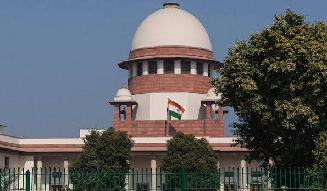

The Supreme Court stayed a Madras High Court order directing a blanket ban on cow or calf slaughter in Tamil Nadu on the eve of Bakrid or on any other day. A bench led by Justices Vikram Nath and Sandeep Mehta passed the interim order while issuing notice to respondents after the Chief Minister Vijay’s government challenged the HC’s order.
The state government argued that the order enforcing a complete prohibition on cow slaughter was contrary to the Tamil Nadu Animal Preservation Act, 1958. Under the law, the slaughter of cattle is allowed in specific situations, including if the animal is more than 10 years old or past their breeding age or no longer suitable for agricultural work, subject to the issuance of the required certificate.
The bench observed that the last paragraph of the Madras HC’s order, imposing the state-wide ban, prima facie required “correction,” as reported by Live Law.
Laws governing the conditions for cow slaughter in Tamil Nadu
Senior Advocate Dr Abhishek Manu Singhvi represented the State in the apex court. Apart from the Tamil Nadu Animal Preservation Act, 1958, other applicable laws such as the Prevention of Cruelty to Animals (Slaughter House) Rules, 2001, the Prevention of Cruelty to Animals Act, 1960, the Tamil Nadu Urban Local Bodies Rules, 2023, and the Tamil Nadu Urban Local Bodies Act, 1998, also govern the conditions for the slaughter of animals but do not impose a total ban. By ordering a complete prohibition, the HC has, according to the State, substituted judicial legislation for statutory law.
HC passed order on May 27
The High Court bench led by Justices GR Swaminathan and V Lakshminarayan passed the order on May 27, Bakrid eve, on a Public Interest Litigation submitted by the General Secretary of Hindu Makkal Katchi, K Surya Prasanth. Though the petitioner sought directions to ensure that the slaughter takes place in designated places only, the HC passed a blanket ban on the slaughter of cattle anywhere on any day.
State challenges HC’s order
While issuing the order, the HC relied upon a Govt order which observed that a ban on the slaughter of cows was essential to improve milk production and enhance the rural economy. The court also referred to the top court precedents, which observed that cow slaughter was not an essential religious practice for Bakrid celebrations.
Challenging the HC’s order, the state argued that when the legislation permits cow slaughter of a particular category in designated places, a judicial order conflicting with the statutory provision cannot be sustained. The State objection relied on Govt Order No. 1715 despite its validity or applicability never being a matter of dispute before the court.