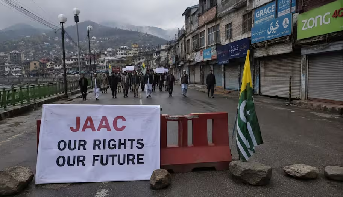

Once again a huge wave of civil agitation has brought Pakistan-occupied Kashmir (POK) to a complete halt with strikes, closure of markets, and street agitation paralysing governmental functioning across Rawalakot, Muzaffarabad, and surrounding areas. Under the leadership of the Joint Awami Action Committee (JAAC), agitators have handed over a stringent 38-point “Charter of Wants” to the government of Pakistan.
And the JAAC has made it clear that this agitation would continue without any break till the charter is implemented officially by Islamabad.
The main trigger: Hydro-electric exploitation and power charges
The key trigger behind the current agitation is the energy crisis of the area. Despite the presence of water bodies and contribution to the power grid of Pakistan through megadams, the residents of the region.
Protesters are demanding provision of electricity through local hydroelectric projects at the cost price of the actual local production. In addition, they are asking for credit of hydel royalty for such local projects like Mangla Dam to the regional exchequer with immediate cessation of additional taxes, fuel adjustment charges, and sudden power outages.
High inflation: Urgent needs of food and agricultural subsidies
Due to tough economic conditions, people’s anger has risen, and the charter puts much emphasis on their struggle against inflation:
- Subsidised wheat flour: A need to set the price of flour at subsidized rate like Gilgit-Baltistan.
- Essential commodity subsidies: Institutional subsidies for sugar, ghee, and other kitchen essentials.
- Farming assistance: Financial help and high-quality seeds and fertilizers to local farmers.
Political rivalry: Putting end to Islamabad’s influence
The JAAC’s charter clearly opposes Islamabad’s rule over this region and is calling for the complete abolishment of the 12 reserved seats in the legislative assembly.
Moreover, the charter calls for more financial and administrative autonomy for local authorities, absolute freedom for local civic organisations, a reformed constitutional power-sharing arrangement. To address the problem of corruption, there is a demand to impose a ceiling on the number of cabinet ministers, to strip bureaucrats of luxuries, and to conduct a judicial review of last decade’s expenses.
Healthcare, infrastructure and protest against police violence
The charter covers a range of issues related to a lack of adequate public infrastructure and basic healthcare services in PoK.
In addition, the JAAC has also fiercely criticized the latest measures adopted by the state against civilian protesters. The association demands that all charges of anti-terrorism against civilians be withdrawn, freedom for all arrested leaders, and an official inquiry against cases of police brutality.
Although there have been many rounds of talks between the leaders of JAAC and officials from Pakistan, the discussions have gone nowhere.