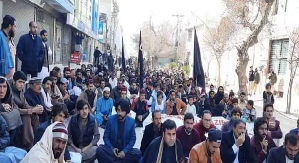

A massive protest in Pakistan-occupied Kashmir (POK) has further intensified the region’s political turmoil, as thousands of demonstrators gathered near the Line of Control (LoC).
They declared that “POK is not part of Pakistan” and warned Islamabad that continued restrictions on food supplies could compel residents to seek “other roads”, a remark widely interpreted as a signal of possible closer engagement with India.
The demonstration at Rawalakot’s Eidgah Ground represented one of the strongest challenges to date against Pakistan’s control over the region. Protesters accused the Pakistani government and security forces of decades of political neglect, economic exploitation, and administrative repression. They further alleged that authorities had imposed a blockade on essential food supplies with the aim of weakening the movement.
Addressing thousands of protesters, Joint Awami Action Committee (JAAC) leader Sardar Amman Khan delivered one of his strongest speeches yet against Islamabad, declaring that POK did not belong to Pakistan.
“POK is not a part of Pakistan. We do not need Pakistan; rather, it is Pakistan that desperately needs POK,” Khan told the crowd.
His remarks were met with loud applause from the demonstrators, many of whom waved flags and raised slogans against Pakistan’s administration.
The protest comes amid a growing anti-government movement that has gained momentum across parts of POK in recent weeks. Thousands of protesters have been staging a continuous sit-in at Rawalakot for more than three weeks, despite mounting pressure from the authorities.
Referring to the sit-in near the LoC, where protesters have been camped since June 9, Khan accused the Pakistani administration of trying to force the movement into submission by cutting off essential supplies.
He also urged Pakistan’s leadership to de-escalate the situation, saying the administration should respect the people’s will instead of resorting to force.
Protesters said the latest phase of the agitation began after the Pakistani authorities blocked the movement of food grains, flour, and other essential commodities into parts of POK.
According to the protesters, the restrictions were aimed at weakening the movement by creating shortages and intensifying economic pressure on local residents.
The latest wave of protests did not emerge suddenly; it stems from years of growing resentment over governance, rising prices, and what many residents describe as an unequal distribution of the region’s resources.
For a long time, people in POK have been demanding subsidies on wheat, flour, and electricity, arguing that despite the region producing significant hydropower, a large portion of it is supplied to Pakistan’s provinces while local households continue to face high electricity bills.