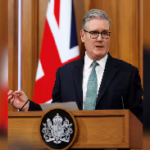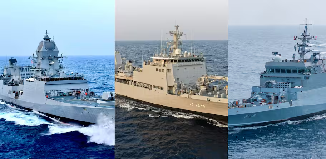

Prime Minister Narendra Modi presided over the commissioning of three indigenously-built vessels in the Indian Navy in Kolkata on Sunday. INS Dunagiri, an advanced stealth frigate; INS Sanshodhak, a Large Survey Vessel; and INS Agray, an Anti-Submarine Warfare Shallow Water Craft.
The induction of these three frontline platforms significantly augments the operational strength and capabilities of the Indian Navy.
Designed by the Indian Navy’s Warship Design Bureau in collaboration with Garden Reach Shipbuilders & Engineers (GRSE), Kolkata, and constructed by GRSE, the ships represent critical capabilities spanning maritime combat, hydrographic survey, and coastal anti-submarine warfare.
Together, they reflect the Navy’s balanced approach to capability development, strengthening blue-water operations, enhancing maritime domain awareness, and securing coastal waters against emerging threats.
INS Dunagiri is the fifth ship of the Project 17A stealth frigate class and is equipped with advanced weapons and sensors, including BrahMos surface-to-surface missiles and the Medium Range Surface-to-Air Missile (MRSAM) system. This greatly enhances the Navy’s multi-role combat capability in the region.
The commissioning of these indigenously built vessels underscores India’s growing self-reliance in warship design and construction under the ‘Aatmanirbhar Bharat’ initiative.
Sanshodhak, the fourth Survey Vessel (Large), is designed for coastal and deep-water hydrographic surveys and collection of oceanographic and geophysical data for defence and civil applications, and is equipped with advanced survey systems including Autonomous Underwater Vehicles and Remotely Operated Vehicles.
Agray, the fourth of the Arnala-class Anti-Submarine Warfare Shallow Water Craft, is equipped with lightweight torpedoes, indigenous rocket launchers, and shallow-water sonar systems to detect and engage underwater threats in littoral waters.
The three platforms demonstrate the growing maturity of India’s indigenous shipbuilding ecosystem, with indigenous content exceeding 75 per cent, the release said.
Their construction involved extensive participation by Indian industry, including more than 200 MSMEs, and generated substantial direct and indirect employment.
At the comissioning ceremoy Prime Minister Narendra Modi said India was once among the world’s largest defence importers, creating strategic and security challenges. After 2014, the government prioritised self-reliance in defence through major policy reforms, boosting domestic design, manufacturing, and exports. He highlighted that India’s defence production has grown from around Rs 40,000 crore in 2014 to nearly Rs 1.8 lakh crore today, while defence exports have surged from about Rs 700 crore to almost Rs 40,000 crore.
The commissioning of these vessels highlights the collaborative efforts of the Government of India, the Indian Navy, public sector shipyards, private industry and MSMEs in advancing the objectives of Aatmanirbhar Bharat and strengthening India’s maritime capabilities, the release said.
(with ANI inputs)