
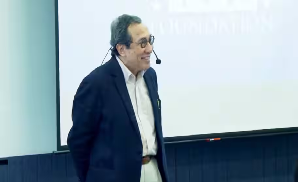

Former Singapore Ambassador Bilahari Kausikan has said that while Pakistan has achieved a diplomatic success by negotiating between the US and Iran, the people are unlikely to benefit from it. Kasusikan also said that Pakistan must stop making excuse of blaming India for its problems. Kausikan made the remarks on Friday while interacting with a group of Pakistani journalists.
When a journalist said that Afghanistan and India are behind Pakistan’s problems, Kausikan said that other people can’t be blamed for everything. “All countries that blame some other country for their problems will never get out of those problems….That (blaming India and Afghanistan) is an excuse. Pakistan has been mismanaged from the beginning. I don’t see any solution. Your politicians are a waste of time…The military is part of the problem,” said Kausikan.
When another journalist asked where Pakistan would stand five years down the line, Kausikan gave a blunt reply. “I will be very blunt. Pakistan was very agile and very successful in taking advantage of a diplomatic opportunity in the US-Iran war. But that will not feed the Pakistani people. Pakistan has been on the brink of failure for a long time. But that diplomatic success doesn’t change the fundamental reality. I don’t think the US is going to lift, in totality, whatever restrictions it has on Pakistan,” said Kausikan.
Giving yet another reality check to Pakistan, Kausikan highlighted the presence of terror groups on Pakistani soil. “Pakistan is the hotbed for all kinds of estranged groups that may not necessarily be working for US interests. Pakistan’s problems are not diplomatic but much more fundamental and within Pakistan….If Pakistan does not fix its problems, it will always be on the brink of state failure. Everyone is worried about it because you have nuclear weapons. If Pakistan did not have nuclear weapons, no one would care,” said the former Singapore Ambassador.
Notably, Pakistan is facing high inflation, debt and an economic crisis. During the recent tension between Iran and the United States, it worked as a mediator, hoping to gain some financial aid from Washington. However, the US did not extend any olive branch to Pakistan, making Islamabad feel betrayed.
Pakistan’s current economic stability is widely perceived as fragile and overly reliant on temporary stabilization measures rather than deep-seated structural transformation. While government officials point to headline growth figures and a narrowing current account deficit as signs of a turnaround, critics argue these are largely the result of administrative suppression of imports and high interest rates that stifle long-term private investment