
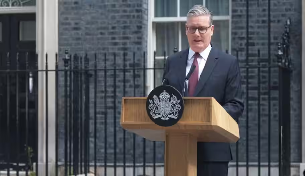

The United Kingdom Prime Minister Keir Starmer announced his resignation as the leader of the Labour Party on Monday. Announcing his resignation, he also mentioned that he will remain as UK Prime Minister until his successor is chosen.
Announcing his resignation at 10 Downing Street, Starmer said, “Every decision I’ve taken has been about putting the country. I love that’s why I will resign as the leader of the Labour Party.”
“I have spoken to this majesty this morning to inform him of my destiny. I will ask the national executive committee of the Labour Party to set up a timetable,” added Starmer.
“Nominations, opening on the 90 fitted by the summer reasons in the case of the contest. This will ensure a new leader is in place. Before Parliament returns in September, I will remain in post as Prime Minister until the contest is complete. I will also give my successor my full and unequivitable support.”
“My party was finished, but we were considered to have a history that the majority of the general election, which alone made a landslide majority possible. But we proved those people wrong, because we changed our part, ripping out the poison about 70, restoring trust in their economy, defence, national security, and becoming a party that once again stood proudly with not against our national flag. The hard work of change was with a singular purpose, not power for powers safe, but to change Britain. For the better to build a fair country with dignity.”
The UK Prime Minister’s resignation came amid growing pressure on Starmer that had intensified in recent months andescalated sharply after Labour Party rival Andy Burnham won a parliamentary seat last week, which could enable him to mount a formal leadership challenge.
Starmer had on Friday said he “would fight any challenge to his leadership and urged Labour not to tear itself apart with infighting.”
Despite leading Labour to a landslide victory in the 2024 general election, Starmer had reportedly faced growing internal dissent following controversies and policy reversals, which critics say have impacted public confidence in his government.
More than 100 Labour MPs, around a quarter of the party’s parliamentary strength, have publicly called for him to either resign or outline a clear exit timeline.
Meanwhile, Burnham is being viewed within Labour circles as a leading contender to succeed Starmer, either through a negotiated transition or a leadership contest.