
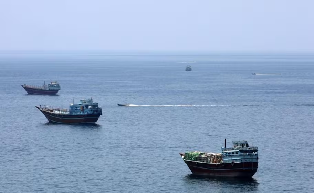

Iran has announced that it will start charging ships to pass through the Strait of Hormuz. Friendly nations, like China, will get “special treatment” under this new plan. Iran’s ambassador to Beijing, Abdolreza Rahmani Fazli, shared this news on Saturday. He stated that Tehran now views the busy waterway as a matter of national security rather than just a route for trade.
Oman brought into the new arrangement
Speaking at the World Peace Forum in Beijing, Ambassador Abdolreza Rahmani Fazli said that Tehran is also working with Oman on fresh arrangements for managing traffic through the strait, which the two countries now frame as a matter of national security rather than a purely commercial shipping route.
Tehran pushes back on western naval presence
The fee announcement follows sharp comments from Iranian Deputy Foreign Minister Kazem Gharibabadi, who insisted that outside military powers have no business projecting force in the strait. In a post on X, he said Iran remains the “responsible power and guarantor” of security in the waterway and cautioned that any military movement there would be watched closely. He added that those responsible for stoking tension would face consequences for what he called their “adventurism.”
UK-France statement triggered the response
Gharibabadi’s warning came directly after a joint statement from UK Prime Minister Keir Starmer and French President Emmanuel Macron. The two leaders said Oman had agreed to work with London and Paris to keep its territorial waters safe for shipping, calling the strait “a vital artery for the global economy.” They said the UK and France are ready to join a larger multinational military effort, if necessary, to ensure freedom of navigation, while respecting regional sovereignty and international law.
Iran rejects western-led security summit
Days earlier, on July 2, Iran had already criticised a US-backed security summit held in Bahrain. Gharibabadi argued that the meeting had no authority to set security terms for the Persian Gulf, stating plainly that “Hormuz is defined under Iran’s command, not CENTCOM,” and dismissing the summit’s capacity to establish legitimate order in the region.
Washington’s position remains unchanged
The United States continues to treat the Strait of Hormuz as international waters, governed by the right of transit passage under maritime law. Washington has consistently opposed any unilateral Iranian move to restrict shipping or impose fees without international agreement. This stance sits awkwardly against a US-Iran memorandum signed in June 2026, which was meant to guarantee toll-free passage through the strait, even as sporadic military friction between the two sides continues.
Why the Strait matters to the world
The Strait of Hormuz carries close to a fifth of the world’s oil and liquefied natural gas each day. Any disruption to traffic through it tends to ripple outward fast, pushing up oil prices and unsettling trade routes that depend on predictable passage through the chokepoint.