
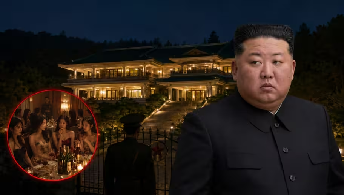

The reclusive personal lives of North Korean leader Kim Jong Un and Kim Jong Il, the late father of the current ruler, have been unveiled due to shocking revelations by a former officer of the elite secret service of the regime. Defecting from the isolated nation after realising how deep the gap of inequality and abuse of human rights was, Lee Kang-jin served as the personal bodyguard to Kim Jong Il for 13 years. Kang-jin’s first-hand account provides a revealing glimpse into the secluded “pleasure villas” and childhood years of the supreme leader.
Life in the secret service: Forced loyalty and the ‘secret child’
Enrolled in the exclusive protection command when he was just 17 years old, Kang-jin described the psychological pressure put on the security personnel. As soon as the guards joined, they were forced to stay away from the world for more than a decade.
“We were explicitly ordered to live and die for the Supreme Leader. If he dies, we die. Our minds were completely brainwashed to believe that the leader was simply resting to relieve exhaustion brought on by working for the nation,” the former bodyguard stated.
Kang-jin was assigned to guard the regime’s most tightly controlled and fortified housing facilities that were named Teukgak (Exclusive Villas). The vast majority of these sites are located in remote regions such as Wonsan, Songam, and Changsong. Many of them are built very close to the Chinese border to prevent possible attacks from enemy missiles or even airplanes.
It was when Kang-jin worked in one of the Teukgak estates that he first met young Kim Jong Un. In those days, the young leader was completely secluded from the public as a “secret child” and unknown to all except his family members and upper management of personal security staff.
Midnight party time: Behind the walls of ‘pleasure squads’
In the words of the defector, the working procedure on the premises of highly protected luxury estates followed a special luxurious procedure intended solely for pleasure of the ruling family and its entourage.
However, with Kim Jong Un preparing to take power, the parties took a different form altogether, shifting into pool parties during the day and banquets at night.
The regime would select between 25 and 30 women in the range of 16 to 20 years old from around the nation to staff the villas. Before entry into the estates, the girls had to undergo rigorous medical examinations to ensure that they did not have any diseases whatsoever.
Placed into individual rooms, these groups—the “Pleasure Squads” of external observers’ jargon—would live in one villa for two or three months, before being replaced to attend to new festivities.
Guarding the gates: Auditory witness to infinite excess
Although it was their responsibility to guard the immediate surroundings of these banquets, the guards were not allowed to enter the rooms where the events were happening. Although they could listen to the music through the walls, they were told to keep looking the other way. Shoot on sight was the order of the day for any commoner who dared to get close to the outer limits of the building.
The contrast between the interior luxury and the reality of the North Korean populace eventually drove the elite guard to orchestrate a high-risk defection.
“Inside those hidden walls, the world’s most expensive alcohol, premium meats, and global delicacies were consumed or simply dumped into trash bins,” Kang-jin recalled. “But the moment I stepped outside those luxury complexes onto the actual streets, I saw the bodies of citizens lying dead from starvation. Seeing people beg for a single scrap of food while the elite threw away fortunes is why I chose to risk my life and escape.”