
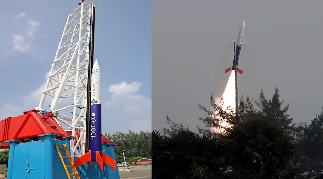

India has entered a new phase in its space journey with the successful launch of Vikram-1, the country’s first privately developed orbital rocket built by Hyderabad-based startup Skyroot Aerospace. The rocket lifted off from the Satish Dhawan Space Centre in Sriharikota on July 18 as part of the Mission Aagaman.
The launch puts a private Indian company in the orbital launch vehicle market, a space that was earlier dominated by government-backed missions. Vikram-1 has been developed to carry small satellites into Low Earth Orbit (LEO) and is aimed at providing commercial launch services for customers looking for fast and more flexible access to space.
Skyroot Aerospace Co-Founder Pawan Kumar Chandana said the mission was named “Aagaman”, which means arrival, as the company moved from test flights to commercial orbital launches.
“Earlier we launched Vikram-S under Mission Prarambh. Now the launch of Vikram-1 has been named Mission Aagaman,” he said.
What makes Vikram-1 special?
Vikram-1 is built to carry satellites into Low Earth Orbit (LEO) with an aim to target small satellite launches. At present, the rocket has a payload capacity of 350 kg, though Skyroot plans to increase this capability to 500 kg in future missions.
Chandana said, “The final payload capacity of Vikram-1 will be 500 kg, but presently we are launching it with a 350 kg payload.”
The rocket can carry a 350 kg satellite to LEO and a 260 kg satellite to Sun-synchronous orbit. It can place satellites at an altitude of around 500 km above earth.
Named after Indian space pioneer Vikram Sarabhai, the rocket is around 20 metres tall and weighs about 40 tonnes. Chandana said, “This rocket weighs 40 tonnes and is 20 metres tall, which is almost equal to a seven-storey building. It has the capability to carry satellites at a speed of 8 kilometres per second.”
Skyroot said Vikram-1 has a diameter of 1.7 metres and a thrust capability of 1,200 kilonewtons. The rocket uses a 3D-printed liquid engine, which the company says is around 50 per cent lighter than conventional engines. Its solid fuel boosters use carbon composite structures made from carbon fibre.
Six payloads on board
Vikram-1 is carrying six payloads as part of its mission. These include five payloads developed in India and one built by German company Dcubed GmbH.
“We are sending five payloads made in India and one payload developed by German company Dcubed GmbH,” Chandana said.
Skyroot Aerospace was founded in 2018 by former ISRO engineer Pawan Kumar Chandana and Naga Bharath Daka. In November 2025, the company set up its 2 lakh square feet facility, called Infinity Campus, in Hyderabad.
In May this year, Skyroot became India’s first private space technology company to achieve unicorn status.
From Vikram-S test flight to orbital rocket
Skyroot’s journey began with Vikram-S, which was launched on November 18, 2022. It became the first rocket developed and launched by an Indian private company.
The rocket travelled for 301.4 seconds and reached an altitude of 88.8 km. It carried three payloads from Bazoomq Armenia, Space Kidz India and N-Space Tech India.
Describing Vikram-S as a stepping stone, Chandana said, “Vikram-S was a kind of test rocket. After its success, we built Vikram-1 within three years.”
How Vikram-1 compares with ISRO rockets
India presently uses three major launch vehicles developed by the ISRO – the PSLV, the GSLV and the LVM3.
The PSLV is used mainly for launching satellites into polar and Sun-synchronous orbits and can carry around 1,750 kg of payload to an altitude of about 600 km. The GSLV is used for heavier satellites, including communication satellites, and can carry around 2,250 kg to Geosynchronous Transfer Orbit and about 6,000 kg to LEO.
ISRO’s heaviest launch vehicle, the LVM3, can carry around four tonnes to Geosynchronous Transfer Orbit and up to 8,000 kg to the LEO.
Vikram-1 is much smaller compared to these rockets and is built specifically for small satellite launches. The aim is to provide a dedicated option for companies and organisations that need fast access to space.
Vikram-2 planned for 2027
Skyroot has announced plans for Vikram-2, which is expected to be launch in 2027. The next rocket in the series will have a higher payload capacity of 900 kg to LEO and 600 kg to Sun-synchronous orbit.
The company plans to use carbon composite structures and an advanced cryogenic engine in Vikram-2.
India’s rising private space industry
The launch of Vikram-1 comes after major policy changes aimed at encouraging private participation in space activities. The government introduced the Indian Space Policy in 2023 and allowed 100 per cent foreign direct investment in the space sector from 2024.
More than 300 startups have entered India’s space sector over the past decade. According to government data, the number of space startups increased from one in 2022 to around 200 by 2024.
India’s share of the world space economy stood at around 2 per cent, valued at $8.4 billion, in 2021. The government expects the sector to grow to $44 billion by 2033, with exports reaching nearly $11 billion.
With Vikram-1, the country’s private space companies have taken their first major step into the commercial orbital launch market and opened new possibilities for small satellite missions and space-based services.