
India has strongly rejected questions about press freedom and human rights raised by a Norwegian journalist during Prime Minister Narendra Modi’s visit to Oslo, with a senior foreign ministry official defending the country’s democratic record while taking aim at what he called narratives peddled by “ignorant NGOs.”
The exchange began at the venue of the Prime Minister’s visit on Monday when Norwegian journalist Helle Lyng called out to Modi, urging him to take questions from the press. Visuals from the room showed the Prime Minister walking out as she did so. Lyng was subsequently invited to an official media briefing held by senior officials from India’s Ministry of External Affairs.
At the briefing, she did not hold back. “As we strengthen our partnership, why should we trust you? Can you promise that you will try to stop the human rights violations that go on in your country? And also, will the prime minister start taking critical questions from the Indian press at some point in the future?” she asked, adding that she would like a straight answer.
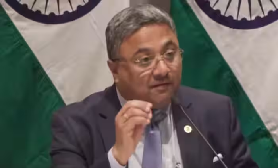
Sibi George, the MEA’s Secretary (West), responded at length, defending India’s constitutional framework and pushing back hard against what he described as foreign misconceptions shaped by selective reading.
“We have a constitution which guarantees the rights of the people, fundamental rights of the people,” he said. “In 1947, we gave the freedom to vote to our women. In many countries I know, the voting right for women came several decades after India gave that freedom. Because we believe in equality, we believe in human rights. And what is the best example of human rights? The right to change government, the right to vote. And that is what is happening in India. We are so proud of that.”
George also pointed to the breadth of India’s media landscape, arguing that foreign observers consistently underestimate the country’s scale and complexity. “We have how many breaking news stories coming every day in the evening. At least 200 TV channels in Delhi alone, in English, Hindi, and multiple languages. People have no understanding of the scale of India,” he said.
He was particularly sharp in his criticism of those who rely on outside reports to judge India’s internal affairs. “They read one or two news reports published by some godforsaken, ignorant NGOs and then come and ask questions,” he said, insisting that India’s rich domestic debates are routinely reduced to simplistic narratives abroad.
At several points during his response, George asked Lyng not to cut him. “Let me answer the question, please don’t interrupt me. You asked a question, this is my press conference,” he said firmly.
Reaffirming India’s standing on the world stage, George pointed to the country’s role during the COVID pandemic and highlighted its civilisational legacy in mathematics, culture, and democratic tradition. “India is a country that believes in the rule of law. We have always been following rules wherever it is. We play by the book. That is India’s reputation,” he said.
The Oslo episode is the second such confrontation in the space of a few days. During Modi’s visit to the Netherlands, George fielded similarly pointed questions from a Dutch journalist who raised concerns about the absence of a joint press conference and asked about press freedom and the treatment of minorities, particularly Muslims, in India. On that occasion, too, George attributed the questions to a “lack of understanding” of India’s history and social fabric.