
Tara Kartha
Not only are the Iranians beginning to suspect Islamabad’s credentials, but data is now emerging about the extent of lobbying that Islamabad did to get its ‘special relationship’ with President Trump. Not that lobbying is at all illegal on the Hill. It’s just that a state that is struggling to pay its bills to its creditors seems to be spending massive sums in the process.
But the extent of benefits that the back-channel has delivered is instructive. In some ways, that’s the answer to a question of how Rawalpindi remains a constant factor in US politics.
The Lobbying Group
A recent report mentions the services of a prominent lobbyist, Stephen Payne, head of Linden Strategies, who was critical not just to getting Gen Asim Munir into the White House but also to suggesting that he nominate Trump for the Nobel Peace Prize. In other words, not just access, but a communication strategy that came up trumps. The story of Payne is astonishing and began in 2001, through a group known as Team Eagle, which seems to have been hired in 2024 on behalf of Pakistan military-linked entities, at an annual fee of $1.5 million. A spurt of spending happened in 2025, with new firms listed. These included Javelin Advisors, enlisted for policy advocacy; Orchid consulting, Squire Patton Boggs, one of the largest firms engaged in such activities, and which is credited with lowering Islamabad’s tariff rates; and Goddard Gunster Strategies, led by Republican operative Gerry Gunster – who was involved also in the Brexit referendum – to represent Pakistan’s Ministry of Interior, emphasising counterterrorism cooperation and bilateral security ties. These are powerful entities, and at different times have even represented Pakistani political parties.
The Big Money In Influence-Peddling
The key issue here is the amount of money being paid out. Javelin Advisors, for instance, was paid $200,000 in just six months in the first half of 2025, apart from arranging expensive hotels and parties for unknown people. It also paid for valuables to the tune of $15,000 to various Republican Senators, one of whom, interestingly, was praising Trump’s peacemaking skills during the India-Pakistan crisis in the Senate.
The firm itself was contracted for $50,000 per month for such services through Seiden Law, which was paid $1.5 million to work under the direction of the Embassy to reach out to the White House, National Security Council, Department of War, and other important ministries. Then there was Qorvis Holding, which did various public relations tasks for the Pakistan embassy, while Squire Patton Boggs provided ” legal and public policy advocacy and advice”. It was also tasked with not just pushing Pakistan’s line on Kashmir mediation but was also busily engaged in denying any ‘China angle’ to the whole Operation Sindoor saga, while selling the narrative that India was involved in assassinations in the US and Canada. Qorvis was also engaged in propagating Pakistan’s reasons for supporting a Nobel prize for Trump, praising his “great strategic foresight and stellar statesmanship …which de-escalated a rapidly deteriorating situation, ultimately securing a ceasefire and averting a…broader conflict between the two nuclear states that would have had catastrophic consequences for millions of people in the region and beyond”.
In sum, during the period of ‘Operation Sindoor’ launch and ceasefire, Embassy officials reached out to 60 officials through these ‘informational materials’, apart from phone calls and emails. It was this network of paid – and entirely legal – professional people who worked to get Pakistan back into the system. Lobbyists like Payne have been crucial in this process, even after the worst of circumstances.
Persuasive Powers
Consider, for instance, that following the 9/11 crisis, this backchannel was able to brush aside all censure for harbouring al Qaeda, notwithstanding which it still managed to get a huge five-year USD 3 billion US aid package. In a press meeting with President George W Bush and Musharraf, not only did Bush deny the pressure brought to bear on Pakistan – the famous ‘with us or against us’ ultimatum – but he also accepted Rawalpindi’s assurance of ‘de-Talibanisation” of Afghanistan and working with Americans to bring Osama Bin Laden to justice. That was 2006. In 2011, that so-called ‘assurance’ was played out with Bin Laden being caught next to an army camp in Abbottabad. Even more ironically, the Taliban were brought back to full power in 2021. This is beyond lobbying. This is an effective whitewash.
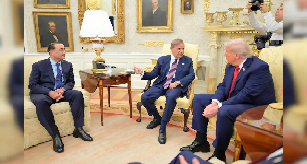
But lobbyists didn’t just employ persuasive powers. According to his own account, Payne was also critical in messaging the White House after getting a call from a panicked Gen Musharraf, who was threatening to carry out a total nuclear use against India after Delhi mobilised thousands of troops in the aftermath of the Parliament attack. A return call was made to Pakistan in seven hours, which in itself is remarkable in terms of access. That essentially saved Musharraf’s career and probably his life. What other access the lobbyists are now providing will only be clear down the line when such exchanges are declassified, especially in terms of what Gen Asim Munir promised in his now-famous lunch at the White House, and what was expected in return. Such prime meetings are set up only for vital reasons. Apart from all of the above, there are other tentacles that act as force multipliers in influence operations.
Other Groups And The Interplay
Then there is a range of legitimate bodies like the PAKPAC (Pakistan American Public Affairs Committee), which are building on an increasingly affluent Pakistani population and work on causes like Islamophobia and anti-discrimination. All fair goals. However, some of these groups, such as the Association of Physicians of Pakistani Descent of North America (APPNA), whose constitution specifically includes ‘educating policymakers’ – knowingly or otherwise – also tie up with interest groups like Friends of Kashmir and various Khalistani organisations, all of which are heavily infiltrated by Pakistani intelligence. The whole Gurpatwant Panun story, that Delhi seriously planned to assassinate him, ran for a long time on the basis of little or no evidence, even in India. Panun has been around for decades, and most of the time, it was ignored by Indian intel as a distraction.
Clearly, however, all these forces, together with other ’causes’ such as Palestine – a huge issue both in the US and in Pakistan – act to reinforce each other, sometimes publicly (like the anti-Israeli Ban Divest Sanction Movement) or quietly through protests and media outreach. Again, noteworthy is the surprising access to funds. It may help to know that in the US, the Chinese and Pakistani embassies also work in tandem to push narratives that are favourable to both.
The bottom line, however, is that whatever Pakistan is doing in narrative building, it is doing right. It’s not just the Trump effect, but a continuous and focused selling of misinformation to an American public that knows very little about the issues involved. As commentators note, Pakistan outspent India three to one in such activities in 2025, despite being about a tenth of the Indian economy. It’s not that India is scrimping on funds. Bureaucratic hurdles for any embassy are immense, and few have the training on how to reach out to the right people at the right time. This should not be through intelligence folks – in fact, they should be kept out of what is essentially an entirely transparent process – but must be built into the training of our foreign service staff, so that available assets are well-managed, and the right story is put out, quickly and continuously. Indian embassies the world over are not exactly top of the line in providing updated information. In fact, even briefs on bilateral relations are sometimes old. All in all, rather than a Chinese ‘wolf warrior’ approach, follow the Kautilya model of seeing diplomacy as part of continuous proactive warfare. And warfare overall is just getting dirtier.