
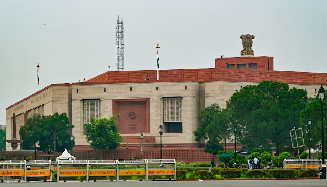

The government has called an all-party meeting on 19 July, a day before the Monsoon Session of Parliament begins, and the government is expected to outline its legislative agenda and opposition parties are likely to spell out the issues they intend to raise during the session.
Officials said the all-party meeting, which is held before every session of parliament, will be held at 11 am.
The government has a full legislative agenda and is expected to consider several key pieces of legislation during the session.
The session is likely to be stormy as some opposition parties have experienced divisions and “breakaways” in recent weeks.
There has been turmoil in Trinamool Congress after its defeat in the assembly polls with 20 of its MPs merging with National Citizens Party of India. They have demanded separate seats in the Lok Sabha. Three-party MPs have resigned from their Rajya Sabha seats and have joined the BJP.
There has been a further “split” in Shiv Sena (UBT) with six of the party’s MPs in the Lok Sabha joining the Shiv Sena led by Maharashtra Deputy Chief Minister Eknath Shinde. Earlier, seven AAP MPs in the Rajya Sabha had joined the BJP.
The Opposition is likely to bring up the NEET-UG paper leak case and Defence Minister Rajnath Singh’s remarks on casualties in Operation Sindoor. The Congress has served a notice of breach of privilege to the Defence Minister.
Union Parliamentary Affairs Minister Kiren Rijiju earlier said that the Monsoon Session of Parliament will be held from July 20 to August 13.
“On the recommendation of the Govt of India, Hon’ble President, Smt. Droupadi Murmu ji has approved the summoning of both the Houses of Parliament for the Monsoon Session 2026. The Session will commence on July 20, 2026, and continue till August 13, 2026, for meaningful debate, discussion, and decisions on issues of National Importance,” Rijiju said in a post on X.
The Joint Parliamentary Committee (JPC) on the proposed 130th Constitution Amendment Bill is also likely to adopt its report on July 17 before placing it in Parliament. The Bill has generated a political controversy over a provision that makes it mandatory for the Prime Minister, Chief Ministers and Union or State ministers to be automatically removed from office if they are in judicial custody for 30 consecutive days in cases involving serious offences.