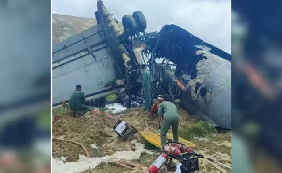

A quiet Saturday morning in Assam turned into a day of mourning for the nation. At around 10 am, an Indian Air Force AN-32 transport aircraft crashed while trying to land at the Jorhat air base. Five IAF personnel made the supreme sacrifice in the line of duty. The co-pilot survived and is now being treated. The aircraft did not reach the runway and came down outside the airstrip, after which firefighting and rescue teams rushed to the spot. The entire station was sealed as recovery operations went on.
The IAF has expressed its deepest grief and ordered a court of inquiry to find out exactly what went wrong. The five who lost their lives were Sqn Ldr Prashant Singh, Flt Lt Shubham Kumar, Sgt Jitendra Sharma, Agniveervayu Khemaram Kumawat and Agniveervayu Danish Alam. Behind each name is a family, a story, and a young life given in service of the country.
To understand this tragedy, one must understand the aircraft and the place it flies. The AN-32 has been the backbone of the IAF transport fleet for over 40 years. These Soviet-origin twin-engine machines arrived in the mid-1980s and are deployed everywhere, from Ladakh and Leh in the north, to the Andaman and Nicobar Islands and Lakshadweep in the south. Jorhat, the famous “Tea Capital of India” and “Cultural Capital of Assam”, has been their home for more than 35 years.
For decades, these aircraft were lifelines. Before roads and infrastructure reached the remote corners of Arunachal, Nagaland, Manipur and Tripura, almost everything moved on these planes. They carry troops and cargo, evacuate the injured (called CASEVAC), do search and rescue, and deliver relief during disasters. They even perform para assault landings, where soldiers jump out using parachutes into strategic areas. Their clever roll-on/roll-off design lets cargo or equipment be loaded and unloaded quickly, so the same plane can switch roles within minutes. The design was originally developed in Ukraine, and the IAF was upgrading these aircraft with modern avionics and new engines before the Russia-Ukraine war disturbed those plans.
So why do accidents happen? According to a senior officer who once headed flight safety in the IAF, this crash likely occurred during the landing phase. About 90 percent of all air accidents, both civil and military, take place during takeoff and landing. These are the two most critical moments of any flight, because the aircraft is flying at the extreme edge of its performance, very close to its stalling speed.
Stalling speed is the minimum speed at which a plane can stay safely in the air. Below it, the wings stop producing enough lift and the aircraft begins to lose height. It works much like a bicycle, ride too slowly and it wobbles and falls. During landing, the plane is low to the ground and near this stalling speed. If anything goes wrong — a technical fault, loss of power, or a small handling error, the crew has very little time and height to recover. That is why such moments turn fatal so quickly.
What makes IAF flying truly demanding is the terrain. The difference between commercial and military flying is huge. These planes go into valleys, gorges and hills where no other aircraft dares. There is no radar coverage, no navigation aids, often heavy clouds and pouring rain. Pilots must thread through narrow gorges and land on semi-prepared strips just 3,000 to 3,500 feet long, with only one direction of approach. There is no room to overshoot or undershoot, a small error means hitting a river, trees or a mountain ridge. The skill required is of an exceptionally high order.
This is also why past AN-32 crashes occurred. In June 2019, an AN-32 with 13 on board went missing after taking off from Jorhat for Mechuka in Arunachal; the wreckage was later found in the mountains and all were lost. In July 2016, another AN-32 with 29 personnel vanished over the Bay of Bengal on the Chennai-Port Blair route, with debris identified only in 2024. Other crashes near Rinchi and the Padi Hills also involved bad weather and difficult terrain. In some cases, pilots entered the wrong valley in thick clouds. Many valleys have escape routes, but some are “dead valleys”, so narrow, with peaks rising 15,000 to 20,000 feet ahead, that there is no space to turn back.
The lesson is clear. The AN-32 is not an unsafe aircraft. The conditions it is asked to fly in are simply extreme, because that is what the IAF does. For over two decades, these planes sustained the army and civilians of the North and Northeast, dropping rations, medicines and supplies where landing was impossible. As Jorhat mourns, the nation salutes both the machine and the brave crews who fly it into the harshest skies on earth.