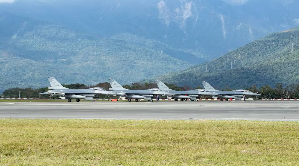

Overtaking Russia and placing itself behind only the United States, China’s air force has moved into the second spot in international rankings. The development is being seen as one of the most important changes in international military aviation in recent years. It comes from rapid expansion, domestic production and a push towards advanced combat technologies.
The People’s Liberation Army Air Force (PLAAF) now operates one of the largest modern fighter fleets outside the United States. Open-source military aviation estimates suggest that the PLAAF has around 110 to 130 fighter formations, with a total fleet of roughly 2,000 to 2,500 combat aircraft. These numbers place it ahead of Russia and show the scale of China’s long-term investment in air power.
China’s rapid build-up in air power
China’s rise in air force strength comes after more than a decade of military modernisation. The country has expanded its domestic aerospace industry, increased aircraft production and developed advanced systems that include stealth fighters, integrated sensor networks and electronic warfare capabilities.
This push has been guided by the need to prepare for high-intensity operations in the Indo-Pacific region. Chinese military planning has placed strong emphasis on readiness for potential conflict scenarios involving major regional actors. While no direct peer competitor exists in the immediate neighbourhood, the country continues to position its air force for broader strategic competition with major powers.
The PLAAF today operates across multiple theatres, including areas facing Taiwan, the South China Sea, Japan and the western Pacific. Defence databases estimate that out of its total inventory of around 3,733 aircraft, more than 2,100 are combat-capable platforms.
Russia’s position after long-term challenges
Once considered among the strongest in the world, Russia’s air force now holds a lower position in comparison. Estimates place the Russian Aerospace Forces at around 1,300 to 1,500 combat aircraft. This decline in relative strength is due to years of operational losses, production constraints and the impact of ongoing military commitments, including the war in Ukraine.
Sanctions and industrial constraints have also limited Russia’s ability to modernise at the same pace as China. As a result, its fleet composition has faced challenges in keeping up with newer-generation systems being introduced elsewhere.
India is fourth in world rankings
The Indian Air Force continues to hold the fourth position in international rankings, according to the World Directory of Modern Military Aircraft (WDMMA). The ranking system does not rely only on aircraft numbers but uses a ‘True Value Rating’ that includes operational readiness, training quality, logistics strength and domestic manufacturing capability.
India’s total military aviation strength, including fighters, transport aircraft, helicopters and trainers, is estimated at around 1,700 to 1,900 aircraft. Within this, the combat fleet accounts for more than 500 fighters. Indigenous programmes such as the Tejas have also contributed to New Delhi’s evaluation in the ranking system by adding domestic production capability to its operational profile.
Changing balance in international air power
China’s rise to the second position shows how fast the international air power structure is evolving. The difference between major air forces is no longer defined only by numbers but also by technology, production capacity and the ability to sustain operations across multiple regions.
With the United States still maintaining the largest and most advanced air fleet, what follows is how China continues to increase its capabilities and how other major powers, including Russia and India, respond to the changing military aviation environment.