
The Pakistan-mediated negotiations between the United States and Iran collapsed in Islamabad after more than 21 hours of marathon talks, with no agreement reached to convert a fragile two-week ceasefire into a lasting peace deal.
As the US Vice President boarded Air Force Two, making his way back to Washington without an agreement, Iranian state media described the breakdown as a direct result of what they called America’s “excessive demands” prompting a firm “BIG NO” from Tehran.
In an X post, the Iranian Embassy in Ghana claimed the talks collapsed after Iran rejected U.S. demands it “could not achieve through war.”
“Iran said a big no, the talks are over.”
Although Iran’s Foreign Ministry spokesperson Dr. Esmail Baghaei stated, “We reached understandings on several issues, but 2–3 major points saw persistent differences, preventing an overall agreement,” posted the Consulate General of the I.R. Iran in Mumbai in an X post.
A high-profile failed peace talk
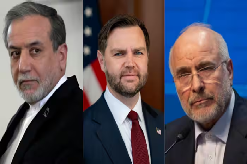
The talks marked the highest-level direct engagement between Washington and Tehran since the 1979 Islamic Revolution. U.S Vice President JD Vance led the American delegation, which included US Special envoy to the Middle East Steve Witkoff and the President’s son-in-law Jared Kushner.
Iran’s team, led by Iran’s Parliament speaker Mohammad Bagher Ghalibaf, included Foreign Minister Abbas Araghchi, along with others.
The negotiations were held following a temporary ceasefire in a conflict that had involved the Strait of Hormuz, Lebanon, and Iran’s nuclear program.
What Went Wrong: The Iranian Perspective
According to Iran’s foreign ministry and its state broadcaster, the Islamic Republic of Iran Broadcasting (IRIB) and Press TV, the U.S side presented a series of “excessive” demands that Tehran viewed as non-starters.
These reportedly included stringent restrictions on Iran’s nuclear program, control or guarantees over the Strait of Hormuz, where Iran holds significant leverage, and other security concessions that Iranian officials said went far beyond any prior understandings.
Press TV explicitly reported that “the talks in Islamabad have ended after the US’s ‘excessive demands prevented a framework from being reached.’
Iranian parliamentary speaker Mohammad Bagher Ghalibaf had earlier outlined preconditions, including the release of frozen Iranian assets and a Lebanon ceasefire, steps Tehran claimed were mutually agreed upon but not fully honored before substantive talks began.
In short, from Tehran’s viewpoint, the U.S arrived not to negotiate in good faith but to extract concessions it could not win on the battlefield. Iran’s response was unequivocal: a “BIG NO.”
Denial of ‘an affermative commitment’
Meanwhile, US Vice President JD Vance, speaking to reporters before departing Islamabad, offered a different assessment. He stated that Iran “chose not to accept our terms,”
Halting Iran’s nuclear capabilities remained a core American goal that was not met. Vance announced no agreement had been reached.
He described the outcome as “bad news for Iran” far more than for the United States, noting, “We’ve had a number of substantive agreements with the Iranians, that is the good news. The bad news is that we have not reached an agreement. That is bad news for Iran, much more than it is bad news for the United States of America.”
“We’re going back to the United States having not come to an agreement,” Vance told reporters. He emphasized that the U.S had clearly outlined its red lines and areas of flexibility, but Iran “chose not to accept our terms.” Vance reiterated Washington’s push for Tehran’s firm commitment against pursuing nuclear weapons or the means to build them, adding, “We just could not get to a situation where the Iranians were willing to accept our terms.”
Despite U.S flexibility, Vance said, the talks made no headway. “We leave here with a very simple proposal, a method of understanding that is our final and best offer. We’ll see if the Iranians accept it.”
What’s Next?
The collapse of talks in Islamabad leaves the two-week ceasefire in limbo and raises fears that fighting could resume, particularly around the Strait of Hormuz, where Iran’s leverage has already disrupted global energy markets.
Noting the deep mutual distrust, the U.S sees Iran as unwilling to compromise on its nuclear ambitions and regional influence, while Iran views American demands as an attempt to dictate terms rather than negotiate.
For now, the “BIG NO” from Tehran has closed this round of talks. Whether it leads to renewed escalation or a return to the table remains to be seen.