

For many years, India has faced one simple but big question. How can a country with the largest population in the world get enough electricity, and at the same time stop depending too much on coal, oil, and gas? Surprisingly, a part of this answer is now coming from a land far away — Australia.
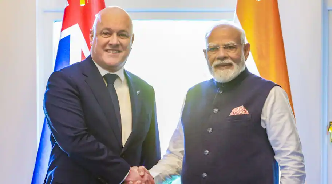
During Prime Minister Narendra Modi’s recent visit to Australia, India signed an important uranium supply agreement with the Australian government in Canberra. This deal may give a strong push to India’s dream of clean energy. Both countries confirmed the signing of an administrative arrangement, which is simply a practical step to make the 2015 Australia-India Nuclear Cooperation Agreement work smoothly. Under this, Australia will now sell uranium to India, only for peaceful purposes. In simple words, Australia will supply the fuel so that India can make more electricity without burning fossil fuels.
But why is Australia so important here? The reason is that Australia holds nearly 28% of all the known uranium in the world. That is a huge amount. Interestingly, Australia itself does not run any nuclear power plants and does not keep nuclear weapons. Instead, it digs out this valuable mineral and sells it to other countries that use it to produce clean electricity in a safe and peaceful way.
Now let us understand India’s plan. By the year 2047, India wants to build 100 gigawatts of nuclear power capacity. To put it simply, that is enough electricity to light up around 60 million homes. This is a very big target. Over the last ten years, India’s nuclear power capacity has already doubled. Yet, nuclear energy still gives only about 3% of the total electricity produced in the country. So there is a long way to go.
One of the main reasons for this slow growth has been the shortage of uranium, which is the basic fuel needed to run nuclear plants. Prime Minister Modi said that this new agreement will open the path for India to receive uranium from Australia and give fresh strength to the country’s clean energy goals. He also added that cooperation in critical minerals — like lithium or rare earths used in batteries and modern technology — is important for both strategic security and the clean energy journey.
To understand the full story, we must go back in time. For many years, India faced restrictions in buying uranium because it has not signed the Nuclear Non-Proliferation Treaty, known as the NPT. This treaty was signed in 1968 and is one of the most important agreements in the world for nuclear safety. Its main aim is to stop the spread of nuclear weapons, encourage countries to reduce their weapons, and support the peaceful use of nuclear energy.
Under this treaty, only five countries — the United States, Russia, the United Kingdom, France and China — are officially accepted as nuclear-weapon states. They promise not to share nuclear weapons with anyone. All other member countries promise never to make or buy such weapons. At the same time, every member agrees to slowly reduce nuclear arsenals. The treaty also allows nations to use nuclear technology for good purposes like producing electricity, treating diseases, improving farming and doing scientific research. To make sure no country cheats, the International Atomic Energy Agency (IAEA) sends inspectors to check that nuclear material is not secretly used for making weapons.
India has always called this treaty unfair. It developed its nuclear technology on its own and chose not to sign the treaty, which it sees as unfair to later nuclear powers. The treaty accepts only those nations that tested nuclear weapons before 1967, and leaves out India, whose first nuclear test happened in 1974. After India again tested nuclear weapons in 1998, several countries put sanctions on it, and buying uranium became even harder.
The real turning point came in 2008. That year, the Nuclear Suppliers Group gave India a special waiver, which allowed member countries to do civilian nuclear trade with India. After this, India signed uranium deals with several nations, including Canada. Australia had also agreed in principle under a 2015 pact, but only if the fuel stayed under IAEA safeguards. This new arrangement finally clears the path for long-term supplies.
However, this friendship is not only about uranium. India and Australia have also decided to deepen defence cooperation, strengthen critical mineral supply chains, and work together on space projects. This includes a temporary Indian space-tracking facility on Australia’s Cocos Keeling Islands, a tiny group of islands in the Indian Ocean that belong to Australia.
Though neither country openly named China, this deal comes at a time when both are increasing cooperation across the Indo-Pacific region. For India, this uranium deal is not just about fuel. It is about faster clean energy, better energy security, and a stronger strategic friendship in a fast-changing world.