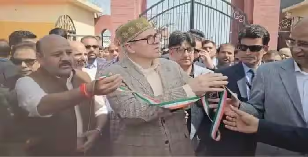

Jammu and Kashmir Chief Minister Omar Abdullah, during an event, declined to use scissors on a tricolour-themed ribbon, drawing significant attention for the symbolic gesture. As Abdullah approached the ribbon stretched across the entrance of the “Know Your Artisans” exhibition at Kashmir Haat, he paused upon noticing the saffron, white and green stripes on the ribbon he was supposed to cut. On social media, people praised Abdullah for escaping the alleged ‘trap’ as cutting of the ribbon could have become a weapon for opposition.
People present at the event said he told officials, “I will not cut the ribbon,” and instructed them to untie it instead of using scissors. After carefully untying the ribbon, he handed it back to the organisers with a specific instruction that it should be “kept with respect” and not discarded or damaged.
It is being viewed as a gesture of deep reverence for the national flag, suggesting that cutting the tricolour—even in the form of a ribbon—could be seen as disrespectful. BJP leader Dr Abhijeet Jasrotia characterised the move as a performance and an insult to the Constitution, alleging there was political intent behind skipping traditional ceremonial norms.
The moment was captured on video and widely shared, sparking discussions about symbolic patriotism and respect for national symbols. Beyond the ribbon incident, Abdullah, while speaking to reporters, raised concerns over past delimitation exercises, alleging that constituency restructuring had politically favoured the BJP and its allies.
He said he would attend an INDIA bloc meeting in Delhi to be held at the residence of Congress president Mallikarjun Kharge today, where the opposition is expected to formulate a joint strategy on the proposed bill. He said the INDIA bloc would have to decide together what its response to the bill would be and what role it would play in Parliament. “Individual parties acting alone would not be effective. There is a need for collective decision-making within the alliance,” he said.
Referring to the past delimitation exercise, he said the distribution of seats, the way constituencies were created, the way maps were drawn and the way voters were shifted were all aimed at benefiting the BJP and its allies.
He further said the proposed changes in parliamentary composition, including an increase in the number of Lok Sabha members and provisions for women’s representation, would be examined collectively by the opposition bloc.