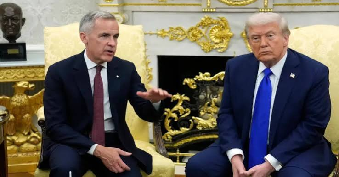

US-Canada trade talks have collapsed after Washington imposed a 50% tariff on nearly $28 billion of Canadian goods, triggering an immediate threat of retaliation. Prime Minister Mark Carney ordered Canada’s negotiators back to Ottawa and said the new US terms were unfair. Washington accused Canada of adding demands and walking back earlier commitments during the final stage.
US imposes 50% tariffs on Canadian goods
The latest trade confrontation escalated late Friday after negotiations between Washington and Ottawa broke down.
At 12:01 a.m. ET, the US imposed a 50% tariff on nearly $28 billion worth of Canadian imports.
Carney immediately directed Canada’s trade negotiators to return to Ottawa. He said the latest US proposals were not acceptable to Canada.
“They have worked hard, in good faith, to defend the interests of Canadians throughout these negotiations up until the very last minute. However, last-minute changes in the U.S. proposed terms were unfair, uneconomic, and called into question the reliability of any deal,” he said.
Canada vows dollar-for-dollar retaliation
Carney said Canada would respond by matching the US tariffs dollar-for-dollar.
He said the move was aimed at protecting Canadian workers and businesses from the impact of the new US trade measures.
“We have recognised from the beginning that America has changed and that we will not return to our old relationship. Our government understood, before many, that America is altering all its trade relationships. Putting tariffs on its closest allies and charging for access to its vast market,” Carney said.
“We have worked in that context. To strike a fair deal that would provide the best access to the U.S. market and greater certainty to Canadian businesses and workers. Throughout, our goal has been to secure the best deal for Canadians, never a deal at any price or on any deadline,” he added.
Carney said the two sides had made progress in recent weeks, but the latest changes to the US proposal meant Canada could not accept the deal.
“As a result, this evening, I have decided to suspend trade negotiations with the U.S. and have directed Canada’s negotiators to return to Ottawa,” he said.
Canada plans more support for workers and businesses
Carney said the Canadian government would introduce additional measures to help workers and businesses affected by the trade dispute.
He pointed to almost $25 billion in support provided during the past 18 months and said further steps would be announced in the coming days.
Canada is also seeking to reduce its dependence on the US market by strengthening domestic investment and finding new export markets.
Carney points to Canada’s wider trade strategy
The Canadian prime minister said the country was moving ahead with nearly $500 billion in major infrastructure projects.
He also said Canada’s existing free trade agreements give the country preferential access to 1.5 billion consumers, with Ottawa aiming to double that market access by the end of this year.
Carney argued that Canada’s economy remained in a strong position despite the trade dispute.
“Our economy is creating jobs at four times the rate of the United States. Our exports to non-U.S. markets are on track to double over the next decade. Foreign direct investment in Canada is at its highest level in two decades, running at twice the rate of our nearest G7 competitor,” he said.
He also said Canada was on course to record the second-fastest economic growth in the G7 over the next two years.
“Canada now ranks as the most attractive country in the world for infrastructure investment,” Carney added.
“Canada has what the world wants. And we will not allow any nation to determine our future. We will set our own course to keep building Canada strong for all,” he said.
Washington blames Canada for trade talks collapse
The US Trade Representative rejected Ottawa’s account of the breakdown and described the situation as a “missed opportunity for Canada”.
Washington accused Canada of introducing new demands and stepping back from earlier commitments during the final stage of the negotiations.
“This is a missed opportunity for Canada to partner with the United States, which is the fastest-growing economy in the G7,” the US Trade Representative said.
“Despite the US offer to Canada to receive the best treatment of any major exporter to our market, new demands and walkbacks of other commitments by Canada have upended the careful balance reached in the past days,” it said in a post on X.
US says it offered tariff relief
Washington said it had offered Canada better treatment in several major sectors, including steel, aluminium, autos and lumber.
The US also accused Canada of maintaining what it called prolonged retaliation against American products and services.
According to Washington, its latest offer included cooperation on export controls, action against trade transshipment and closer coordination on digital trade.
The proposed package also included cooperation on critical minerals, aerospace supply chains and imports linked to forced labour.
The US said the offer would also have opened formal negotiations under the US-Mexico-Canada Agreement, or USMCA.
Canada looks beyond US market
The latest dispute comes as Canada and other countries seek to reduce their dependence on the US market following the Trump administration’s tariff measures.
Canada’s Office of the Chief Economist said exports to the US fell 3.7% last year amid global economic shocks and trade tensions.
At the same time, Canadian exports to markets outside the US rose 11.1%.
Non-US markets now account for 32.8% of Canada’s total exports, or almost one-third of the country’s exports. That is the highest share recorded in four decades.
What the US-Canada tariff dispute means
The breakdown marks a new setback in the trade relationship between two of North America’s biggest economies.
Canada’s decision to match the US tariffs could increase costs for businesses on both sides of the border and put further pressure on efforts to reach a wider trade agreement.