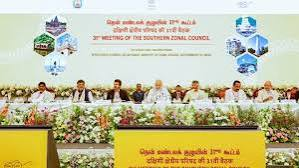

Southern states on Thursday pressed for a greater and fairer share of financial resources, stronger political representation and closer regional cooperation at the 31st Southern Zonal Council meeting chaired by Union Home Minister Amit Shah in Mahabalipuram.
Karnataka Chief Minister D.K. Shivakumar said the economic strength of the southern states was central to India’s growth and urged the Centre to ensure that their contribution was matched by a fair share of funds, resources and political representation.
“Karnataka becoming stronger makes South India stronger, and a stronger South India makes India stronger. We are partners in India’s development. We want fairness in our funds and in our voice. Give us our fair share of resources,” Shivakumar said.
He said he was not attending the meeting to complain, but to raise the legitimate concerns of states that contribute significantly to the national economy.
“I am speaking as a proud Indian and as a proud Kannadiga representing Karnataka, a state with a language and culture that has a history of more than 16 centuries. I am speaking not only for Karnataka but for the entire South India,” he said.
Shivakumar pointed out that the five southern states account for around 20 per cent of India’s population but contribute nearly 33 per cent of the country’s GDP. Karnataka, he said, remains one of the strongest drivers of that economic growth.
He highlighted Karnataka’s position as the country’s leading software exporter, accounting for around 42 per cent of India’s software exports. The state has nearly 1,100 Global Capability Centres, the highest among states, and attracted more than 21 per cent of India’s total FDI equity inflows between 2019 and 2025, he said.
Despite accounting for only around 5.5 per cent of India’s population, Karnataka contributes about 9 per cent to the national GDP, Shivakumar said. The state also accounts for around 60 per cent of India’s aerospace industry, nearly 70 per cent of the country’s coffee production and 90 per cent of processed gherkin exports.
The Chief Minister raised concerns over Karnataka’s reduced share in the divisible pool of taxes, which fell from 4.7 per cent to 3.6 per cent during the 15th Finance Commission period. He said this resulted in an estimated loss of around Rs 65,000 crore over six years.
He also said the 15th Finance Commission had recommended a special grant of Rs 5,495 crore and state-specific grants of Rs 6,000 crore for Karnataka, but these had not been released.
While welcoming the increase in Karnataka’s share from 3.64 per cent to 4.131 per cent under the 16th Finance Commission, Shivakumar said the state’s share should be restored to 4.7 per cent.
“Karnataka is the second-largest contributor to GST and income tax. A state that performs well in growth and revenue should be incentivised, not penalised,” he said.
Shivakumar also sought additional central projects for Karnataka, including the Bengaluru-Mumbai high-speed rail project, the southern section of the Satellite Town Ring Road, an AIIMS in Raichur and a special package for Kalyana Karnataka.
Delimitation and political representation
The proposed delimitation of Lok Sabha constituencies was another major concern raised by Shivakumar. While welcoming assurances that no southern state would lose its existing Lok Sabha seats, he said the issue went beyond numbers.
“Representation is not just about numbers. It is about our influence and our voice. South India has successfully controlled its population while contributing significantly to the country’s economy. Our success should not become the reason for weakening our voice,” he said.
He urged that the 1971 population basis be respected and that the political voice of southern states be protected.
Shivakumar also called for women’s reservation to be implemented without waiting for another census or changing the existing number of Lok Sabha seats.
“Women have waited long enough for their rightful representation. I urge this council to pass a resolution providing women’s reservation while retaining the existing number of Lok Sabha seats,” he said.
Southern states seek greater cooperation
Water cooperation also featured prominently in Shivakumar’s address. He said rivers such as the Cauvery, Krishna, Tungabhadra, Pennar and Palar should unite the southern states rather than become sources of division.
“The time has come to move from water sharing to water cooperation,” he said.
He cited the joint meeting held on June 25 with the Chief Ministers of Andhra Pradesh and Telangana as an example of cooperation on inter-state water issues.
Shivakumar said Karnataka’s approach was based on equality, transparency and cooperation, while stressing that the state’s legitimate water rights must also be respected. He said Karnataka would place its specific positions on the Krishna river, the Upper Bhadra project and the interlinking of rivers before the council.
He also urged the Centre to reconsider the Mines and Minerals (Development and Regulation) Act, 2026, arguing that it affects the states’ rights to levy taxes on major minerals.
The Karnataka Chief Minister further called for stronger laws and enforcement mechanisms to tackle drug trafficking and sought greater support from the Centre for swift and stringent action against traffickers.
“These are not isolated demands. They are questions about how cooperative federalism can be made more effective for our people,” Shivakumar said.
Tamil Nadu calls for a united southern strategy
Tamil Nadu Chief Minister C. Joseph Vijay also called for greater cooperation among southern states, particularly on drug trafficking, economic development, the Blue Economy and federal rights.
Addressing the meeting, Vijay said the southern states contribute more than 30 per cent of India’s GDP and are among the country’s major centres of manufacturing, exports and services.
He called for the region to function as an integrated economic bloc through manufacturing zones, logistics parks and freight corridors.
Vijay welcomed the extension of the Bengaluru Metro from Bommasandra to Hosur, calling it a model of interstate cooperation, and urged authorities to expedite the project.
Calling for a “Drug-Free South India”, he sought greater intelligence-sharing and coordinated enforcement against the interstate trafficking of narcotic and psychotropic substances. He also urged tighter regulation of online sales of prescription medicines and action against unauthorised distribution.
The Tamil Nadu Chief Minister said the Blue Economy should form an important part of the South’s development agenda. With Tamil Nadu having a 1,076-km coastline, he said the state was ready to work with other southern states on ports, coastal shipping, fisheries, marine industries, maritime services and tourism.
Fiscal federalism and river disputes
On fiscal federalism, Vijay said the next Finance Commission’s devolution formula should recognise both need and performance. States that have achieved economic growth, fiscal discipline and population stabilisation, he said, should not be penalised.
He also sought flexibility for states in setting tax rates following the introduction of GST.
On inter-state river disputes, Vijay said the rights of lower riparian states must be protected through the implementation of court judgments, tribunal awards and statutory mechanisms.
He sought timely enforcement of directions concerning Cauvery water and said Mullaperiyar’s safety and storage level, including its increase to 152 feet, should be governed by judicial decisions.
Vijay also reiterated Tamil Nadu’s opposition to NEET and asked the Centre to permit admissions to state-quota medical, dental and AYUSH seats based on Class 12 marks. He argued that the examination disadvantages rural and underprivileged students.
On delimitation, he demanded a legislative assurance that no state’s percentage share of parliamentary representation would be reduced because of successful population control.
“Public policy must not penalise states for fulfilling national objectives,” he said.
Vijay concluded by saying that strong states make India stronger and pledged Tamil Nadu’s cooperation in resolving differences through dialogue, mutual respect and the rule of law.
The meeting was attended by Tamil Nadu Chief Minister C. Joseph Vijay, Kerala Chief Minister V.D. Satheesan, Andhra Pradesh Chief Minister N. Chandrababu Naidu, Telangana Deputy Chief Minister Bhatti Vikramarka and Karnataka Home and IT-BT Minister Priyank Kharge, along with ministers and senior officials from the southern states.
(with IANS inputs)