
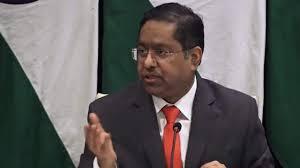

The Indian government issued a strong response after a US federal commission recommended that India be designated a ‘Country of Particular Concern’ (CPC) over alleged violations of religious freedom. The panel also called for targeted sanctions against key Indian entities, triggering sharp criticism from New Delhi.
MEA dismisses report as ‘motivated’
Reacting to the findings, Randhir Jaiswal, spokesperson for the Ministry of External Affairs, said the government categorically rejects the report, describing it as biased and driven by selective narratives.
‘We have taken note of the latest report… We categorically reject its motivated and biased characterisation of India,’ Jaiswal said.
He added that the commission has, for years, presented a distorted and selective view of the country by relying on questionable sources rather than objective facts.
India questions credibility of US panel
Jaiswal further said that repeated misrepresentation of India undermines the credibility of the commission itself. He also urged the body to focus on issues within the United States, including attacks on Hindu temples and concerns faced by the Indian diaspora.
According to the MEA, such incidents in the US deserve serious attention instead of what it described as ‘selective criticism’ of India.
What the US commission recommended
The recommendations were made by the US Commission on International Religious Freedom (USCIRF) in its 2026 Annual Report, which reviewed developments during 2025.
The report urged the US government to designate India as a CPC, alleging that the country has been involved in ‘systematic, ongoing and egregious’ violations of religious freedom.
It also proposed targeted sanctions against individuals and organisations, including India’s external intelligence agency Research and Analysis Wing (R&AW) and the Rashtriya Swayamsevak Sangh (RSS). Suggested measures include freezing assets and denying entry into the United States.
Impact on trade and security ties suggested
The commission further recommended linking future US security assistance and bilateral trade relations with India to improvements in religious freedom conditions.
It also called on the US Congress to revive and pass the Transnational Repression Reporting Act of 2024, which would mandate annual reporting on alleged acts of transnational repression by the Indian government against religious minorities in the United States.
Concerns raised in the report
In its assessment, the USCIRF claimed that religious freedom conditions in India worsened during 2025. It alleged that the government introduced and enforced new laws affecting minority communities and their places of worship.
The report also pointed to efforts by several Indian states to tighten anti-conversion laws, including provisions for stricter prison sentences.
India stands firm
India has firmly rejected all such allegations, maintaining that the report does not present an accurate or balanced picture. The government reiterated that external assessments based on selective inputs cannot reflect the ground reality and emphasised that such reports only weaken the credibility of the institutions issuing them.