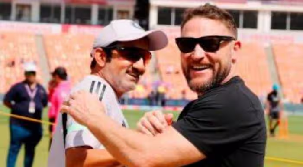

The architectural foundations of England’s “Bazball” era are currently facing their most rigorous stress test to date. Following a devastating and humiliating 4:1 defeat in the recent Ashes series against Australia, the future of Brendon McCullum as the head coach of the England men’s team has shifted from stable to highly precarious. While the captaincy of Ben Stokes appears secure for the immediate future, a new report from The Telegraph indicates that McCullum’s tenure is now explicitly tied to the team’s performance in the upcoming 2026 T20 World Cup.
The ECB’s Internal Post-Mortem
The fallout from the Australian tour triggered an immediate and intensive internal review led by the highest echelons of the England & Wales Cricket Board (ECB). Chief executive Richard Gould and chairman Richard Thompson have spent the weeks following the Ashes debacle dissecting the reasons behind the team’s collapse. While the review suggests that Director of Cricket Rob Key and captain Ben Stokes are likely to be spared and allowed to continue their leadership roles, the sentiment regarding McCullum is notably more fractured.
The board is reportedly grappling with the reality that the team’s Test form has depleted at an alarming rate, and the rot has begun to spread into the white:ball formats. In the boardroom, the ECB has privately acknowledged that the era of total player autonomy and relaxed coaching may have run its course. There is a growing consensus that stricter standards must be implemented to salvage the 2026 season.
The Culture Clash: Discipline vs. “Bazball”
One of the primary points of contention within the review is McCullum’s signature coaching style. Known for a hands:off, empowering approach that encourages freedom of expression, McCullum has built a culture based on trust. However, recent events suggest that this trust may have been misplaced. The ECB is now calling for a return to more traditional, disciplined standards.
The conflict arises from McCullum’s own admission in the past that significant changes to the team’s culture—specifically a shift toward a more rigid or “schoolmaster” approachmight not suit his personal coaching philosophy. This creates a potential impasse: if the ECB mandates a stricter regime, McCullum may find himself ideologically at odds with his employers. Consequently, the 2026 T20 World Cup is being viewed as the final proving ground for whether his methods can still deliver elite results under pressure.
Off-Field Controversies and the Midnight Curfew
Adding to the pressure on the coaching staff is a series of disciplinary lapses that have tarnished the team’s reputation. Public interest was piqued when it was revealed that Harry Brook was involved in a physical altercation with a nightclub bouncer during a tour of New Zealand. Furthermore, reports surfaced that several members of the squad were regularly visiting casinos and consuming excessive amounts of alcohol during the Ashes tour in Australia, leading to questions about the level of professional oversight provided by the management.
In a direct response to these incidents, the ECB has taken the rare step of imposing a mandatory midnight curfew for the players during their current white:ball tour of Sri Lanka. This move is seen as a clear signal that the board is no longer willing to tolerate the “party” atmosphere that some critics argue has contributed to their on:field decline.
The Sri Lankan Assignment
As the team arrives in Colombo, the stakes could not be higher. England is scheduled to play a three:match ODI series followed by three T20Is. The first ODI will take place at the R. Premadasa Stadium on January 22. While these matches are important in their own right, the T20I series is particularly critical as it serves as the final rehearsal before the World Cup. For Brendon McCullum, every tactical decision made in Sri Lanka will be viewed through the lens of his potential departure.
Official Squad Selections
Despite the off field drama, Harry Brook has been named captain for both the T20I and ODI squads, signaling the board’s desire to transition into a new era of leadership on the field.
England T20I Squad:
Harry Brook (Captain), Rehan Ahmed, Tom Banton, Jacob Bethell, Jos Buttler, Brydon Carse, Sam Curran, Liam Dawson, Ben Duckett, Will Jacks, Jamie Overton, Adil Rashid, Phil Salt, Josh Tongue, Luke Wood.
England ODI Squad:
Harry Brook (Captain), Rehan Ahmed, Tom Banton, Jacob Bethell, Jos Buttler, Brydon Carse, Zak Crawley, Sam Curran, Liam Dawson, Ben Duckett, Will Jacks, Jamie Overton, Adil Rashid, Joe Root, Luke Wood.