
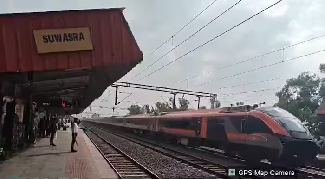

Railways Minister Ashwini Vaishnaw said that due to continous modernisation and upgrades, around 80% of the Indian Railways tracks are now suitable for semi-high speed operations at 110 kmph. The minister also said that around 23% of the track can now handle train operations at a speed of 130kmph. Notably, this comes at a time when the Indian Railways is introducing high-speed trains like Vande Bharat Express to provide hassle-free travel in less time.
“Track supporting 130 kmph and above has grown from 6% to nearly 23%. Track fit for 110 kmph and above has risen from about 40% to 80%. This has reduced journey times, improved punctuality, and made it possible to run semi-high-speed services like the Vande Bharat Express,” said Vaishnaw.
Track Upgrade In Focus
Vaishnaw said that since 2014, about 55,000 km of tracks have been renewed, thus improving safety, ride quality and reducing the need for frequent repairs. He said that around 44,000 track km consisting of long rail panels of 260 m each have been laid.
Explaining further, he said, “Longer panels mean fewer joints, which leads to smoother and safer train movement. Over 80,000 track km of stronger 60-kg rails are now in use, supporting heavier loads and higher speeds.”
The Minister added that advanced technologies like Ultrasonic Flaw Detection (USFD) testing have been carried out across about 36.2 lakh track kilometres and 2.25 crore welds, checking for hidden cracks inside the rail that cannot be seen from the outside. He said that due to this technology, rail and weld failures have come down by about 90%.
“Other methods now in use include phased-array testing for flash-butt welds, magnetic-particle inspection for new welds, and GPS-enabled Oscillation Monitoring Systems (OMS) that measure ride quality and pinpoint the exact location of rough spots on the track,” said Vaishnaw, adding that the track machine fleet has also been doubled from 748 in 2014 to 1,785 in 2026.
Safety Fencing Being Carried Out
The Railway Minister said that with high-speed operations, there is a need for track fencing as well. With train traffic growing each year, maintenance windows between trains are shrinking and thus, machines help get more done in less time without disrupting services, he said.
“About 17,500 km of safety fencing has been installed, especially where trains run above 110 kmph, helping prevent trespassing by people and cattle. At points and crossings, 36,000 thick-web switches and 7,500 weldable CMS crossings have been provided — these last longer and allow smoother train movement,” said the Railway Minister.
Over 25,000 Trains In Operations
Sharing details of daily traffic, Vaishnaw said that Indian Railways operates more than 25,000 trains across India every day. They carry more than two crore passengers daily and move large quantities of coal, iron ore, grains, steel, cement and other commodities across a network of over 1,37,000 kilometres of tracks.
Q. How many trains are operated by Indian Railways daily?
Indian Railways operated 25,000 trains on average every day as of April, 2026.
Q. How many passengers travel using Indian Railways daily?
As of April 2026, over 2 crore passengers use the Indian Railways services across the country.
Q. What is the total track length of the Indian Railways?
The Indian Railways has a track network of over 1,37,000 kilometres as of April 2026.
Q. How much has track safety improved since 2014?
Significant technological upgrades have led to a 90% reduction in rail and weld failures. Consequently, the total number of accidents dropped from 135 in 2014–15 to just 16 in 2025–26, representing an 89% overall improvement in safety.
Q. What technology is used to find hidden cracks in the tracks?
Indian Railways uses Ultrasonic Flaw Detection (USFD) testing to identify internal cracks that are invisible to the naked eye. Other advanced methods include phased-array testing for welds and GPS-enabled Oscillation Monitoring Systems (OMS) to pinpoint rough spots on the track.
Q. Why is the ‘ballast’ layer under the tracks so important?
The ballast (crushed stone) provides drainage, absorbs vibrations, and keeps the track stable. Because these stones powder over time due to heavy traffic, the Railways has performed ‘deep screening’ on over 1 lakh km of track to restore the bed’s stability and function.
Q. How has the speed potential of the network changed?
The network has seen a massive shift toward higher speeds. In 2014, only 40% of tracks supported speeds of 110 kmph or above; by 2026, that figure has doubled to 80%. Specifically, tracks fit for 130 kmph and above grew from 6% to nearly 23% of the total network.