
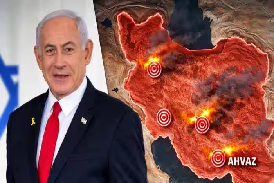

Israel Defense Forces (IDF) on Friday said that Israeli Air Force fighter jets struck more than 200 Iranian targets over the past day, including ballistic missile launchers, air defense systems, and weapon production sites.
In a statement, the IDF said that dozens of fighter jets carried out around 20 large-scale strikes across western and central Iran, guided by military intelligence. The strikes were aimed at Iranian military infrastructure in an effort to reduce missile fire toward Israeli territory.
“Over the past day, dozens of Israeli Air Force fighter jets completed 20 wide-scale strikes in western and central Iran, guided by IDF intelligence. As part of the strikes, over 200 Iranian terror regime targets, including ballistic missile launchers, defense systems, and weapon production sites, were targeted,” IDF said in a statement.
However, there has been no independent confirmation of the reported Israeli attacks. The extent of the damage and destruction caused by the strikes also remains unclear, and there were no immediate reports of casualties.
In a separate post on X, the IDF said it had targeted locations in Shiraz, Tehran, and Ahvaz as part of ongoing operations against what it described as Iranian military infrastructure.
According to the IDF, the targets included:
Shiraz (southern Iran): An underground facility used for the storage and production of ballistic missiles.
Tehran: A central base for the aerial defense array, as well as several production sites for weapons, air defense systems, and ballistic missile components.
Ahvaz (western Iran): Command centers, including facilities linked to the Islamic Revolutionary Guard Corps’ Ground Forces and an internal security command center.
Foreign workers were killed in Oman
Meanwhile, reports citing Oman’s state news agency said that two foreign workers were killed and several others injured after debris from a downed drone fell in an industrial area in Sohar province.
West Asia war
The current conflict in West Asia began after Israel and the United States reportedly carried out a joint strike on Iran on February 28, which Iranian sources claim killed Supreme Leader Ayatollah Ali Khamenei along with several senior officials.
In retaliation, Iran launched missile and air strikes targeting U.S. military bases in Iraq, Qatar, the UAE, Bahrain, Kuwait and Saudi Arabia. Tehran also hit air defence systems and military facilities in neighbouring countries it accused of assisting the U.S. operation. Iranian authorities later said they would halt attacks on these states if they ensured their territories were not used for further strikes against Iran.
Now in its 14th day, the Iran-US-Israel war has caused extensive damage across the region. Iranian state media and the Foundation of Martyrs and Veterans Affairs report more than 2,000 casualties so far, with Iran accounting for the majority, including over 1,300 civilian deaths. At the same time, the disruption of traffic through the Strait of Hormuz has left millions of barrels of oil unable to reach global markets, driving benchmark crude prices towards the $100 mark and raising concerns about a renewed surge in worldwide inflation.