

People’s Conference President and MLA Handwara, Sajad Gani Lone, on Sunday sharply criticised what he described as a dangerous attempt to “communalise medical sciences” in the controversy surrounding the admissions at the medical school under Shri Mata Vaishno Devi University.
“This is too much of a stretch. The BJP is now experimenting with the concept of communalising medical sciences,” Lone said, urging a return to constitutional values and academic fairness.
Highlighting that medical admissions follow a uniform national system, he said, “There is a proper admission test called NEET, and it is an All-India examination.”
Lone said, “The finest brains in the country sit for that exam. Those who get selected work hard to become doctors—and these doctors treat patients, perform surgeries, and save lives.”
He went on to say, “Some of the brightest minds go even further. They dedicate themselves to research, innovate, and develop methods to defeat diseases. They spend their lives experimenting in laboratories.”
Citing advancements in medical science, he said, “Look at how medicine has progressed in the last few decades — the MRI machine, the CT scan.”
Lone argued that reducing such a prestigious field to a political dispute insults generations of scientists. “Those who made these breakthroughs would turn in their graves knowing medicine is being dragged down by undereducated political leaders infusing communalism into a noble discipline.”
Calling for higher intellectual standards in political leadership, he added, “I wish a basic minimum level of IQ were made mandatory to enter public life.”
He further asserted that India should be striving for leadership in global medical research instead of internal polarization. He said, “India should be collaborating internationally in research. We have not contributed to medical sciences at the level expected. We need the best minds, innovation, and a research-driven culture — not religious zealotry. Medical science needs researchers, not fanatics.”
Iltija Mufti, daughter of PDP chief Mehbooba Mufti, also criticised the BJP’s stance. Writing on X, she attacked Chief Minister Omar Abdullah, saying, “In Naya Kashmir, discrimination against Muslims has now extended to education. The irony is that this apartheid is being justified in India’s only Muslim-majority region under its only Muslim Chief Minister. Shameful.”
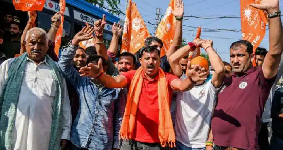
The BJP, along with several Hindu organisations, has objected to the high number of Muslim students selected in a medical college funded by a Hindu shrine, arguing that since the institution operates on Hindu donations, it should prioritise Hindu students — similar to minority institutions that reserve seats for their respective communities.
They have demanded that the current admission list be cancelled and that the rules be amended to ensure more Hindu students in future batches, alongside initiating the process to grant the institution official minority status to enable such reservations.
A J&K BJP delegation led by Leader of Opposition Sunil Sharma met Lieutenant Governor Manoj Sinha — who also serves as chairman of the university — to convey these concerns. Sharma said, “We have strong reservations about the initial admission list in which 42 out of 50 students are from the Muslim community. This has caused widespread anger and distress among Hindus who donate to the shrine, so we met the LG to seek a review.”
However, officials clarified that admissions were conducted strictly in line with National Medical Commission (NMC) rules, which mandate that all government and affiliated private college seats (excluding management or NRI quotas, which do not apply here) must be allotted based on NEET merit and J&K domicile criteria.
They reiterated that religion plays no role in the centralised NEET counselling process and that, without official minority status, the college cannot legally introduce a religious quota.
The admission of a Muslim-majority batch of students at the Shri Mata Vaishno Devi Institute of Medical Excellence (SMVDIME), a medical college funded through donations to the Hindu shrine, has triggered significant political controversy in Jammu and Kashmir (J&K). Several Hindu organizations and BJP leaders protested the admission list, arguing that the institution should prioritise Hindu students, while officials asserted that the admissions were entirely merit-based and conducted under national guidelines. The debate has now intensified after a Kashmir-based political leader entered the discussion.