
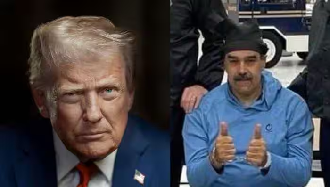

The US conducted a daring military operation on Saturday, capturing Venezuelan President Nicolás Maduro to execute a US federal arrest warrant for narcoterrorism.
After his arrest, Maduro was flown to the United States, where he will face trial for his alleged involvement in narco-terrorism conspiracy, cocaine importation conspiracy, and firearms-related crimes.
He is accused of using his position of power in Venezuela for more than two decades to facilitate the transport of massive quantities of cocaine into the United States.
Questions Raised On Legitimacy Of US Action
However, questions are being raised about the operation’s legitimacy under international law, with experts largely considering it unlawful.
US Justification
US officials justified the strikes and Maduro’s capture as executing a US federal arrest warrant for narcoterrorism, based on the 2020 Southern District of New York indictment renewed in 2026, accusing Maduro of leading a cartel trafficking drugs into the US. Officials called Maduro a “fugitive of American justice” rather than framing it as political intervention.
Legitimacy Of US Action
Article 2(4) of the UN Charter prohibits force against any state’s territorial integrity or political independence, requiring UN Security Council authorization for military action.
Sitting heads of state enjoy absolute immunity from foreign criminal jurisdiction. US narcoterrorism indictments (renewed in 2026 from 2020) do not permit extraterritorial raids or justify airstrikes on Caracas, nor Delta Force operations, without self-defense, UN approval, or the host country’s consent.
Venezuela’s disputed leadership does not override sovereignty protections under the UN Charter or the 1970 Declaration on Friendly Relations.
Role of International Arrest Warrants and Criminal Indictments
US domestic indictments or bounties confer no extraterritorial enforcement rights under international law and do not legitimize invasion or abduction.
Arrest of foreign nationals is permitted only if they visit the prosecuting state, and even then, it allows for arrest, not military action.
Only the International Criminal Court (ICC) warrants impose arrest duties on states parties during such visits, not military operations. Unilateral warrants issued by one state against another country’s leader undermine sovereignty without Security Council backing.
Impact
This sets a dangerous precedent, potentially encouraging other nations to take unilateral action against leaders of rival states and justifying similar strikes by powers like Russia or China against indicted leaders, destabilizing global order