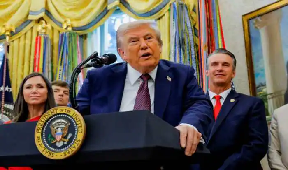

U.S. President Donald Trump took to the stage once again to defend his controversial tariff policies, calling them the secret weapon behind his success in settling international disputes. He emphasised that his tariffs not only boosted the U.S. economy but also gave the country a “great negotiation ability”.
Speaking to reporters about the relocation of the U.S. Space Command headquarters to Huntsville, Alabama, on Tuesday, he referred to his tariff strategies as the ultimate solution to global economic tensions. “I settled seven wars,” he claimed proudly, adding that many of those resolutions stemmed from trade issues. “Tariffs were key to making those deals happen,” he continued.
Trump’s defense of his economic policies, though bold, was marked by his usual flair for exaggeration. He maintained that the revised duties created a stronger U.S. economy and claimed that the tariffs were the driving force behind much of the nation’s financial success. “Without the United States everything in the world would die. It is true. It is so powerful,” he declared.
He also lashed out at the previous U.S. administration, suggesting that under President Joe Biden, America had “started to degenerate”.
Reflecting on his presidency, Trump said, “We built it up to a level that I never thought we could be at this quickly. We are the hottest. We are the best. We are the best financially. The money coming in is so big because of tariffs and other things, but because of tariffs. Tariffs get us even those other things. Plus, it makes us great negotiators.”
Defense Of 50% Tariff On India
Trump also revisited his decision to impose a 50% tariff on Indian imports, claiming the move was a necessary response to what he described as a “one-sided” trade relationship. The president argued that India had been charging the United States some of the highest tariffs globally, creating an unbalanced situation.
“We get along with India very well,” Trump acknowledged, “but for many years, it was a one-sided relationship… India was charging us tremendous tariffs. They were the highest in the world”.
He argued that the tariff imbalance was preventing fair business exchanges between the two nations.
Trump’s critique included specific reference to the American motorcycle company, Harley Davidson, which he said faced severe challenges because of India’s 200% import tariff on motorcycles. “Harley Davidson could not sell in India, as there was a 200 percent tariff on a motorcycle… Harley Davidson went to India and built a motorcycle plant, and now they do not have to pay tariffs,” he pointed out, using the example to highlight the impact of tariff barriers.
Global Repercussions Of Tariff Policies
While Trump’s rhetoric emphasised the “success” of his policies, the reality is more complex. The 50% tariff on Indian imports and additional tariffs related to India’s purchase of Russian crude oil have added economic pressure, both on India and on global markets. India, like many nations, now faces a rising sense of uncertainty as it navigates these ongoing trade challenges.
Despite his confident claims, Trump’s remarks continue to generate debate. His tariffs, particularly on countries such as India remain a point of contention and could have long-lasting effects on international relations and trade negotiations. As the president continues to defend his legacy, his focus on tariffs as a negotiating strategy highlights his belief in aggressive trade policies as a way to assert U.S. dominance on the world stage.
The fallout from these policies is likely to continue, especially with the ongoing challenges faced by U.S. companies and foreign nations impacted by these high-stakes tariffs.