
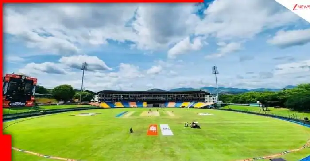

With the ICC Men’s T20 World Cup 2026 fast approaching, pitch intelligence is already shaping team strategies. One venue that will quietly influence results in Sri Lanka’s leg of the tournament is Pallekele International Cricket Stadium. Located in Kandy’s hill country, Pallekele has a clear identity in T20 cricket: competitive first-innings batting, slowing surfaces later in the night, and decisive roles for both smart spinners and disciplined seamers. This deep-dive analysis focuses only on T20 data and conditions, keeping the World Cup context front and centre.
Pallekele is not a neutral venue that fades into the background. It is scheduled to host Group B and Super Eight matches, including high-profile fixtures involving Sri Lanka and Australia. In a tournament where margins are slim, understanding how this pitch evolves over 40 overs can be the difference between qualification and elimination.
Pallekele Pitch Behaviour in T20 Cricket
First innings: Batting-friendly, but not a road
Historically, Pallekele offers true bounce and decent carry early in the match. Batters who trust the bounce and play straight can score freely in the powerplay and early middle overs.
Key numbers underline this trend:
- Average first-innings score: 167–168
- Run rate: 8.3 to 8.5
- 170–180 is a par score, while anything above 185 puts pressure on chasing sides
Stroke-makers enjoy value for shots, but reckless hitting early often brings miscued dismissals due to the slightly larger square boundaries.
Second innings: Grip, turn, and scoreboard pressure
As the match progresses, the surface slows marginally. The pitch does not crumble, but it grips just enough to aid variation. This is where teams with quality spin bowling and clever pace-off options gain control.
This explains the clear pattern:
- Teams batting first have won 14 of 27 T20Is
- Average second-innings score drops to 147
- Run-making becomes harder once the ball gets older
Dew can appear in night games, but it has not been consistent enough to flip the toss logic entirely.
Pace vs Spin: Who Dominates at Pallekele?
Pallekele is one of the rare Sri Lankan venues where both disciplines remain relevant.
- Wicket distribution in T20Is
- Pacers: 57.5%
- Spinners: 42.4%
- What this means tactically
- New-ball pacers get subtle seam movement under cloud cover
- Hard lengths and cutters work better than raw pace
- Finger spinners and wrist spinners thrive once the ball loses shine
This balance makes team composition crucial. Sides relying on only one bowling style often struggle here.
Toss Factor and Match Strategy
Despite occasional successful chases, the numbers still lean towards batting first.
- Why captains prefer batting first at Pallekele
- Surface slows down after 10–12 overs
- Spinners become harder to line up under lights
- Scoreboard pressure increases sharply in chases
Expect most captains to bat first unless rain or heavy dew changes calculations close to match time.
Weather Conditions Around Kandy During February
February offers relatively stable conditions compared to monsoon months.
- Typical match-time weather
- Temperature: 22–25°C
- High humidity
- Cloud cover common
- Light winds
Rain risk exists during afternoons, but night matches usually see minimal precipitation, improving the chances of full 40-over games. Overcast skies can assist swing early, especially for left-arm seamers.
Historical T20 Records at Pallekele
Pallekele has produced some of the most memorable T20 moments in history.
Notable records:
- Highest T20I total: 263/3
- Lowest total: 88 all out
- T20I centuries at venue: 3
This wide scoring range reflects how sharply conditions reward discipline and punish poor execution.
Teams Likely to Benefit at Pallekele in T20 World Cup 2026
Sri Lanka
Home advantage, deep spin resources, and familiarity with tempo shifts make Sri Lanka extremely dangerous here.
Australia
Australia’s power hitters have already shown they can dominate this venue, but their success will depend on adapting once the pitch slows.
Balanced associate teams
Sides like Oman or Ireland, with disciplined bowling and structured batting, can remain competitive if they bat first and apply scoreboard pressure.
T20 World Cup 2026 Matches at Pallekele
Pallekele will host:
Group Stage (Group B)
• Sri Lanka vs Oman – 16th Match (Feb 12, 2026) at Pallekele
• Australia vs Sri Lanka – 30th Match (Feb 16, 2026) at Pallekele
• Ireland vs Zimbabwe – 32nd Match (Feb 17, 2026) at Pallekele
• Australia vs Oman – 40th Match (Feb 20, 2026) at Pallekele
Super Eight Stage (Group 2)
• Super 8 Group 2 match – Feb 22, 2026 at Pallekele (teams TBC)
• Super 8 Group 2 match – Feb 24, 2026 at Pallekele (teams TBC)
• Super 8 Group 2 match – Feb 28, 2026 at Pallekele (teams TBC)
These games are expected to play a decisive role in shaping knockout qualification, particularly for Group B contenders.
What to Expect at Pallekele
Pallekele is a thinking batter’s venue and a tactician’s bowling ground. It rewards teams that:
- Build first-innings totals smartly
- Use spin creatively in middle overs
- Manage pace variations at the death
In T20 World Cup 2026, expect competitive scores, fewer run-fests than flat decks, and matches decided by adaptability rather than brute force.