
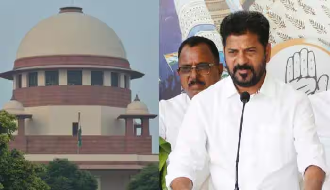

The Supreme Court rejected the Telangana government’s petition challenging the Telangana High Court’s interim order that halted the State’s decision to raise Other Backward Classes (OBC) reservation in local body elections to 42 per cent. The increase would have pushed total reservations in the State’s local bodies to 67 per cent.
A bench comprising Justices Vikram Nath and Sandeep Mehta clarified that the dismissal of the plea would not prevent the High Court from deciding the issue on its merits.
The Telangana government had approached the Supreme Court after the High Court temporarily stayed its move to implement the enhanced quota for OBCs, introduced through the Panchayat Raj (Amendment) Bill, 2025, and the Telangana Municipalities (Amendment) Bill, 2025, passed in August this year.
Senior Advocate Abhishek Manu Singhvi, representing the State, argued that the High Court’s order contradicted the Supreme Court’s nine-judge bench verdict in the Indira Sawhney case, which permitted exceeding the 50 per cent reservation ceiling under exceptional circumstances.
On the other hand, Senior Advocate Gopal Sankarnarayan, appearing for the petitioner opposing the State’s move, maintained that the Supreme Court’s rulings allow reservation beyond 50 per cent only for Scheduled Tribes in Fifth Schedule areas. He further contended that the Indira Sawhney judgment referred to socio-economic reservations in employment and education, not political reservations in local governance.
After hearing all sides, the Supreme Court dismissed Telangana’s plea and directed that the local body elections, which began on October 9, should continue without disruption.