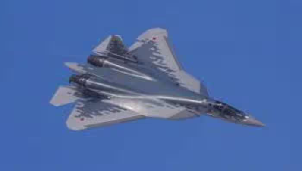

Russia has made India a major offer for its fifth-generation stealth fighter jets. As India’s long-standing partner in the aerospace sector, Moscow has proposed the advanced twin-seat Su-57 stealth fighter. It is designed to strengthen India’s air combat capabilities.
Russia has also offered to provide full technology transfer for the Su-57, allowing India access to critical systems and design details. The proposal was presented at the Wings India 2026 exhibition held in late January.
Reports suggest that Russia aims to revive the previously shelved fifth-generation fighter jet partnership (FGFA) with this offer.
Advanced twin-seat Su-57 stealth fighter
The Su-57E is the export version of Russia’s fifth-generation stealth fighter. It features twin engines and seats two pilots. The aircraft is designed for complex command, control and strike missions and is capable of multi-role operations, including air-to-air combat and managing companion UAVs.
The jet can reach speeds of Mach 2.0 (roughly 2,135 to 2,600 kilometres per hour). It is equipped with five AESA radars, advanced optical sensors and can carry up to 10,000 kilograms of payload.
The advanced Su-57 also incorporates artificial intelligence to assist in combat automation.
Integration of indigenous missiles
If India gains access to the source code, missiles such as BrahMos and Astra could be integrated into the Su-57. India had withdrawn from the FGFA programme in 2018 due to cost disputes, limited roles for Indian engineers and questions around stealth capabilities and engine performance.
Addressing IAF’s needs before AMCA
Following the FGFA withdrawal, India moved focus to its indigenous Advanced Medium Combat Aircraft (AMCA) project. Prototypes for the AMCA are expected by 2029, with production likely starting around 2035.
In the meantime, Russia’s offer of the advanced Su-57 seeks to fill the gap in stealth fighter availability for the Indian Air Force (IAF).
Advantages of the twin-seat Su-57
American fifth-generation fighters like the F-22 and F-35 are single-seat jets. The twin-seat Su-57 offers advantages in modern warfare, particularly in manned-unmanned teaming. The rear-seat pilot can act as a mission commander or mini-airborne warning and control system (Mini-AWACS), while the front-seat pilot concentrates on flying and responding to enemy threats.
Reports suggest that if India approves the Russian proposal, a prototype could be ready by late 2026 or early 2027.