
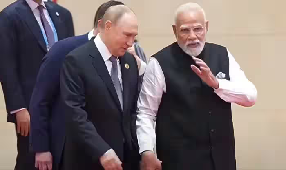

Russian President Vladimir Putin is set to visit India on 4-5 December for the 23rd Annual Summit, his first trip to New Delhi since the outbreak of the Russia-Ukraine war and India’s Operation Sindoor. Defence cooperation is expected to dominate his talks with Prime Minister Narendra Modi, with Moscow placing a new proposal for additional S-400 air-defence regiments at the top of the agenda. The visit is being viewed as a reaffirmation of the long-standing strategic partnership between the two countries.
Russia has reportedly offered to supply two or three more S-400 regiments to the Indian Air Force. The proposal comes at a time when India, though increasingly diversifying its military procurement, continues to rely heavily on Russian-origin equipment, currently estimated to account for 60-70 per cent of its arsenal.
According to the Stockholm International Peace Research Institute (SIPRI), Russia’s share of India’s arms imports has dropped from 76 per cent in 2009 to 36 per cent in 2024, reflecting New Delhi’s determined push towards indigenisation under the ‘Aatmanirbhar Bharat’ initiative and its growing arms partnerships with France and the United States.
Despite this shift, the depth of Indo-Russian defence cooperation remains substantial. Joint programmes include the S-400 system, BrahMos cruise missile, T-90 tanks, and production lines for MiG-29 fighters, Kamov helicopters, T-72 tanks, BMP-2 armoured vehicles, and Navy stealth frigates. The co-development of the BrahMos missile and the AK-203 rifle further illustrates the enduring technological partnership.
Operation Sindoor in May underscored the operational value of the S-400, nicknamed “Sudarshan Chakra” by the Indian Air Force. An S-400 unit in Adampur reportedly shot down a Pakistani aircraft at a range of 314 kilometres, while the IAF confirmed that the system neutralised seven Pakistani aircraft and tracked more than 300 airborne targets simultaneously. Its rapid deployment capability, under five minutes, has been highlighted as a key tactical advantage. The system’s integration along the China and Pakistan borders has significantly strengthened India’s multi-layered air-defence network.
According to sources, Russia’s state-owned defence conglomerate Rostec has already opened preliminary discussions on a fresh S-400 contract, assuring India that future deliveries will be completed on schedule, a priority for New Delhi after previous delays linked to the conflict in Ukraine. India’s original USD 5.43-billion agreement for five S-400 regiments has seen three delivered, with the remaining two due between early and mid-2026.
A notable feature of Russia’s new proposal is an offer of up to 50 per cent technology transfer for S-400 missiles and support systems. This could allow Indian manufacturers, potentially including Bharat Dynamics Limited- to assemble components locally and accelerate production of the 48N6 missile, approved for indigenous manufacture in October. Officials suggest that nearly half of the S-400 support ecosystem could be localised, lowering costs and significantly strengthening India’s domestic defence capabilities.
Despite Russia remaining India’s largest defence supplier, its share of New Delhi’s imports has fallen steeply, from 72 per cent in 2010–2014 to 55 per cent in 2015–2019, and now 36 per cent for 2020–2024, according to the 2025 SIPRI report. The decline reflects India’s diversification strategy and its intent to avoid overdependence on any one country.
Both sides are expected to accelerate negotiations on the expanded S-400 package and other joint programmes during Putin’s visit, to conclude agreements by mid-2026.