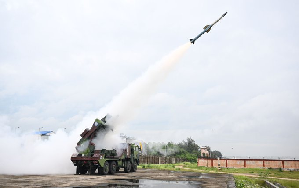

Days after the successful test of Agni-V, India achieved another major milestone by conducting the first flight test of the indigenously developed Integrated Air Defence Weapon System (IADWS) off the coast of Odisha on August 23, 2025. This advanced, multi-layered defence system is a significant leap forward in enhancing India’s capabilities to counter diverse aerial threats, strengthen national security and achieve self-reliance in defence technology.
During the trials, three separate aerial targets — two high-speed fixed-wing UAVs and a multi-copter drone — were engaged simultaneously and successfully neutralised by the QRSAM, VSHORADS, and High Energy Laser weapon systems at varying ranges and altitudes.
All weapon system components, including the missile systems, drone detection and neutralisation technologies, command-and-control systems, radars, and communication equipment, functioned without fault.
What Is IADWS?
The IADWS is a multi-layered defence armour comprising indigenous Quick Reaction Surface-to-Air Missiles (QRSAM), Advanced Very Short Range Air Defence System (VSHORADs) missiles and a high power laser-based Directed Energy Weapon (DEW). Notably, VSHORADS and DEW have been developed by Research Centre Imarat and Centre for High Energy Systems and Sciences, respectively.
Defence Minister Rajnath Singh Hails the Achievement
Hailing the achievement, Defence Minister Rajnath Singh in a post on X, said that the test has validated India’s multi-layered air defence capability and is going to strengthen area defence for important facilities against enemy aerial threats.
The Defence Research and Development Organisation (DRDO) posted a video of the successful trial on X, saying, “Maiden flight Tests of Integrated Air Defence Weapon System (IADWS) was successfully conducted on 23 Aug 2025 at around 1230 Hrs off the coast of Odisha.”
Another Successful Test Last Week
This achievement comes close on the heels of India’s successful test of the Agni-V intermediate-range ballistic missile (IRBM) last week. The nuclear-capable missile, with a strike range of 5,000 km covering nearly the entire Asian continent, underscored the country’s strategic strength, while the IADWS trial further reinforces India’s layered defence preparedness.
The Agni-V missile plays a central role in India’s nuclear deterrence strategy. With a range of around 5,000 km, it is capable of striking targets across most of Asia, including northern China, and even reaching parts of Europe, thereby giving India considerable strategic reach and depth.
Operation Sindoor
India launched Operation Sindoor in May as retaliation to the killing of 26 innocent civilians by Pakistan-sponsored terrorists in Jammu and Kashmir’s Pahalgam area on April 22. As part of the operation, precision strikes were launched on terror infrastructure in Pakistan and Pakistan-Occupied-Kashmir, destroying several terror sites and killing over 100 terrorists linked to Lashkar-e-Taiba (LeT), Jaish-e-Mohammed (JeM), Hizbul Mujahideen (HuM).