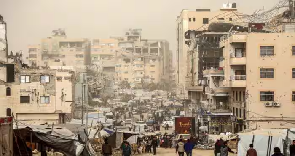

The war involving the United States, Israel, and Iran is now rippling far beyond the battlefield, with its impact sharply felt in Gaza. As fighting enters its eleventh day, residents of the besieged enclave are scrambling to buy basic food items amid rising prices, dwindling supplies, and growing uncertainty over aid deliveries.
Local reports say crowds have returned to markets across Gaza, where shoppers are trying to secure whatever essentials they can before stocks run out. Traders say the cost of several staple items has risen within days, while some products have already vanished from shelves.
The sudden panic buying reflects Gaza’s heavy dependence on outside supply routes. Almost all food, fuel, medicine, and other necessities reach the territory by truck through crossings controlled by Israel and Egypt. Whenever these routes are restricted, shortages quickly spread through markets, hospitals, and water facilities.
Israel shut Gaza’s crossings on February 28 as Israeli and US forces began strikes on Iran, bringing humanitarian access and patient evacuations to a halt. Authorities later reopened the Karem Abu Salem crossing, known in Israel as Kerem Shalom, to allow a gradual entry of aid, though agencies say the current flow remains limited.
The Rafah crossing with Egypt has remained closed, leaving aid organisations warning that the supplies entering Gaza are far below what is required to meet daily needs.
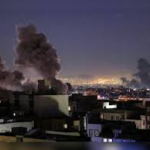
Meanwhile, the conflict itself continues to intensify. Tehran experienced some of its heaviest bombardment overnight during the second week of the war.
US President Donald Trump said on Monday that the conflict could end “pretty quickly”, though he added that he was “not happy” with Iran’s new Supreme Leader, Mojtaba Khamenei, who recently succeeded his father, Ayatollah Ali Khamenei. In Tehran, hundreds of thousands of people gathered in rallies to show support for Mojtaba Khamenei, with many describing the demonstrations as a signal of resistance against the countries attacking Iran.
Developments in Iran
Iranian Foreign Minister Abbas Araghchi said on Tuesday that Tehran would continue fighting for as long as necessary, challenging Trump’s suggestion that the war could end soon.
The Iranian ISNA news agency reported that a US-Israeli air strike hit a residential building in the western city of Arak, killing five people and injuring several others.
Another strike on residential buildings in eastern Tehran left at least 40 people dead. Earlier attacks on oil facilities also filled parts of the capital with thick smoke. According to Iranian authorities, more than 1,255 people have been killed and around 10,000 wounded since the conflict began.
Iran’s parliament speaker, Mohammad Bagher Ghalibaf, warned of a “harsh response” to attacks targeting civilian areas.
At the diplomatic level, Deputy Foreign Minister Kazem Gharibabadi said several countries, including China, Russia, and France, had contacted Tehran regarding a possible ceasefire.
Iran’s foreign ministry spokesperson also accused Washington of attempting to “partition the country” and seize its oil resources.
Trump, meanwhile, told reporters the United States was closely monitoring whether Iran had activated “sleeper cells”, covert operatives living secretly inside another country who can be deployed to carry out attacks.
Developments in Israel
Iran has also continued retaliatory strikes. According to the Tasnim news agency, the Iranian military launched drones targeting an oil and gas refinery and fuel storage facilities in Haifa.
The Israeli army said missiles were fired from Iran towards Israeli territory and that interception efforts were underway.
Trump praised the joint military operations of the US and Israel, claiming the two nations were “crushing the enemy”. He also alleged that Iran had been preparing to attack Israel and would have used a nuclear weapon if it had possessed one.
Emergency workers in Israel reported that one man died from shrapnel wounds at a construction site near Tel Aviv’s international airport, raising the death toll from Iranian attacks to 11.
Global impact
The conflict is also shaking global energy markets. Russian President Vladimir Putin said Moscow was ready to work again with European customers to address a growing energy crisis.
French President Emmanuel Macron said France and its allies were preparing a mission aimed at reopening the Strait of Hormuz, a vital shipping route for global oil supplies.
Bombardments of Iranian oil facilities have pushed up energy prices worldwide. In response, finance ministers from the G7 said they were prepared to release emergency energy reserves to stabilise markets.
The fighting has also disrupted production in several Gulf states, forcing temporary halts in oil and gas output and driving fuel prices higher. Crude oil briefly climbed close to $120 per barrel before falling back to around $90 after Trump warned he would intensify strikes if Iran attempted to block oil shipments through the Strait of Hormuz.
As the conflict stretches into its second week, the effects are being felt from Middle Eastern battlefields to global markets, and most immediately in Gaza, where families are once again bracing for deeper shortages.