
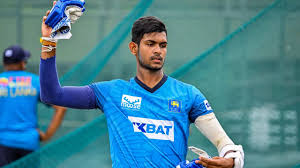

Defending a revised target of 115 in 15 overs, Pathirana returned figures of 1 for 18 in four overs, conceding runs at an impressive economy rate of 4.5 on a surface that largely favoured batting. England eventually chased down the target with six wickets in hand, but the margin of victory masked how effectively Sri Lanka’s bowling unit, led by Pathirana, applied pressure.
Controlled Spell on a Batting-Friendly Surface
While several bowlers on both sides struggled for control, Pathirana stood out for his accuracy and variation. He consistently clocked speeds above 140 kph, touching 148 kph, and showcased his full range, sharp yorkers, well-disguised slower balls, and testing short deliveries.
Notably, two of his overs came inside the powerplay, where he conceded just 10 runs, adapting seamlessly to a role he is more accustomed to executing at the death. Wides, which had previously been an issue, particularly during last year’s IPL, were largely absent, with Pathirana bowling just three across his entire spell.
Speaking after the match, Pathirana explained his unexpected use with the new ball. “Even though I have practised to bowl in the powerplay, there was no plan as such for me to bowl there today. It just so happened that our score was lower than we wanted, so it was decided that I would bowl in the powerplay,” he said, as quoted by ESPNcricinfo.
Long Road Back from Injuries
Pathirana also reflected candidly on a difficult 18-month period marked by recurring injuries that disrupted his rhythm and confidence. He credited Sri Lanka legend Lasith Malinga, along with the national coaching staff, for helping him rediscover his best form.
“Over the last year and a half, along with my injuries, it was a challenging period. I lost my rhythm,” Pathirana said. “I have worked very hard to get back to this level. More recently, Malinga aiya was here in Sri Lanka helping out, as well as all the coaches at SLC. All of them helped me get here.”
Malinga, now serving as Sri Lanka’s fast-bowling coach, is known for his emphasis on target-based drills and high-volume repetition, an approach Pathirana said played a key role in his resurgence.
Back to Basics, Higher Repetitions
Rather than major technical changes, Pathirana focused on refining fundamentals through increased workload in practice. “I didn’t change anything major. Just simple, basic things,” he explained. “The main thing was increasing the number of repetitions in practice. If there is any improvement, that is the reason.”
IPL Setbacks and Revival
The turnaround is especially significant given Pathirana’s recent struggles. After playing only two T20Is last year due to injury and poor form, he was released by Chennai Super Kings ahead of the 2026 IPL season. His previous IPL campaign yielded 13 wickets in 12 matches at an average of 32.61 and an economy rate of 10.13.
However, Pathirana has since earned a major vote of confidence, being picked up by Kolkata Knight Riders for Rs 18 crore, where he is expected to play a key role in their pace attack.
Concerns over Pathirana’s release point, highlighted last season by CSK head coach Stephen Fleming, also appeared to ease during the England T20I. The bowler acknowledged subtle changes but attributed them to injury rather than conscious adjustment.
“In the recent past, I was playing with a fairly major shoulder injury, so I think my body automatically changed the release point,” he said. “Even now, I am doing rehab in between matches, and that’s why you can see the release point getting closer to what it used to be.”