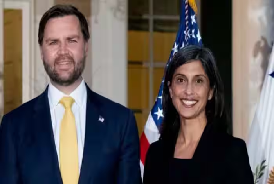

US Vice President JD Vance defended his earlier statement that he hoped his wife, Usha Vance, a Hindu, would become a Christian like him, asserting that she “is not a Christian and has no plans to convert.”
The controversy erupted after Vance’s comments at the Turning Point USA event in Mississippi, where he was asked whether his wife would “come to Christ.” Responding to the question, Vance said he hoped she would one day embrace Christianity, which triggered sharp reactions on social media. Critics accused him of being dismissive of his wife’s Hindu beliefs and seeking approval at the expense of her faith.
Following the backlash, Vance took to X to issue a strong rebuttal. “What a disgusting comment, and it’s hardly been the only one along these lines,” he wrote, reacting to users who accused him of “throwing his wife’s religion under the bus.” He said the criticism reflected “anti-Christian bigotry” and misrepresented his statements.
Vance clarified that his remarks were not intended to undermine his wife’s beliefs. Emphasising that faith is a matter of “God-given free will,” he said he would never pressure his wife to convert. The US Vice President credited Usha for encouraging him to reconnect with his Christian faith, describing her as a major influence in his spiritual journey.
Responding to criticism from Canadian journalist and Rebel News publisher Ezra Levant, Vance said that his marriage with Usha is built on “mutual respect, trust, and understanding” despite their different faiths. He reiterated that while he hopes for spiritual alignment, he fully respects his wife’s Hindu faith.
Vance’s remarks and subsequent clarification have sparked fresh debate in the US over religion, interfaith relationships, and personal faith in public life.