
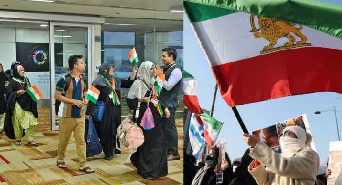

The Ministry of External Affairs isssued fresh advisory for its nationals in Iran, asking them to ‘leave Iran’ by all available means of transport, including commercial flights, amid the escalating tensions between Iran and the United States on Monday.
The directive reflects mounting fears of military confrontation in the Middle East. It arrives just days before the third round of indirect US-Iran nuclear talks, scheduled for February 26 in Geneva. Oman’s Foreign Minister Badr Al Busaidi confirmed the date, building on inconclusive prior sessions in Oman and Geneva. US President Donald Trump has intensified pressure with a 10-15-day ultimatum for a nuclear deal, warning of “unfortunate” consequences for non-compliance.
Reportedly, Oman’s Foreign Minister Badr Al Busaidi confirmed the next round of indirect US-Iran discussions on a nuclear deal will occur on February 26 in Geneva, building on prior mediation efforts. This will be the thrid round of negotiation talks after no clear deal in Oman and Geneva.
US seeks zero enrichment, missile limits, and curbs on proxies; Iran demands full sanctions relief while retaining enrichment rights as an NPT signatory.
Earlier on February 17 in Geneva, US and Iranian officials cautiously agreed on “guiding principles” for nuclear negotiations, a fragile step forward against gathering geopolitical storm clouds.
Iranian Foreign Minister Abbas Araghchi hailed the session as “constructive,” noting broad agreement reached. He stated, “We were able to reach broad agreement… drafts would be exchanged, and a third round date would be set,” signaling plans for detailed proposals ahead of the February 26 follow-up.
Hours later, US Vice President JD Vance tempered enthusiasm, declaring Iran’s stance inadequate. “The President has set some red lines that the Iranians are not yet willing to actually acknowledge,” Vance said, underscoring unresolved gaps on core demands like zero uranium enrichment.
Meanwhile, the US has deployed multiple warships in the Middle East, including the aircraft carrier USS Abraham Lincoln and USS Gerald Ford, nine destroyers, and three frigates, as per AFP reports.
On the other hand, Iran maintains its bold refusals, with Iranian Foreign Minister Abbas Araghchi expressing hope for diplomacy but vowing retaliation to any US attack. President Masoud Pezeshkian echoed this, stating Iran will not yield to global pressure during talks.
Recently Anti-regime protests have also intensified in Tehran and Mashhad universities, targeting Supreme Leader Ayatollah Ali Khamenei amid economic woes.
India’s fresh advisory underscores New Delhi’s caution, prioritising citizen safety underscoring the developments in and around Iran and Middle east, with increased military presence in Gulf.